Mech-Mind Robotics Posts First Interim Results Since HKEX Listing
Mech-Mind Robotics Technologies, the Xiongan New Area-based maker of AI-driven 3D vision and control software for industrial robots, reported first-half 2026 revenue of RMB237.3 million (approximately US$33.2 million), up 54.7% year on year, and gross profit up 63.6%, in its first interim results since its September 1, 2026 listing on the Hong Kong Stock Exchange Main Board.

Industrial robot vision has spent the past two years as mostly a venture-funded story, a bet that AI-guided perception would let robotic arms handle the unstructured, variable tasks that rigid programming has never managed well. That bet now has a public paper trail. Mech-Mind Robotics Technologies Co., Ltd., a Xiongan New Area-headquartered maker of AI-driven 3D vision and control software for industrial robots, reported on September 24, 2026 first-half revenue of RMB237.3 million (approximately US$33.2 million, at roughly 7.15 RMB per US dollar), up 54.7% year on year, in its first interim results since listing on the Hong Kong Stock Exchange (HKEX) Main Board on September 1, 2026.
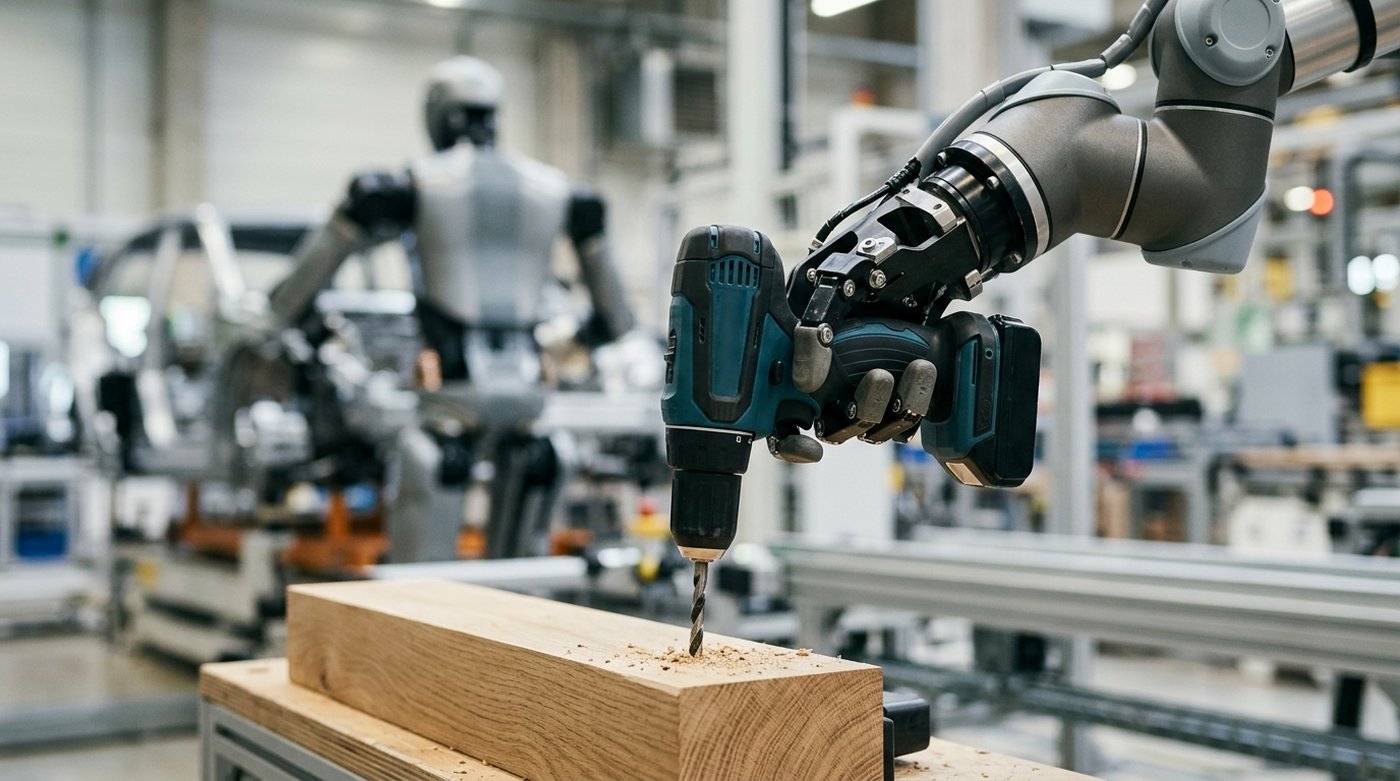
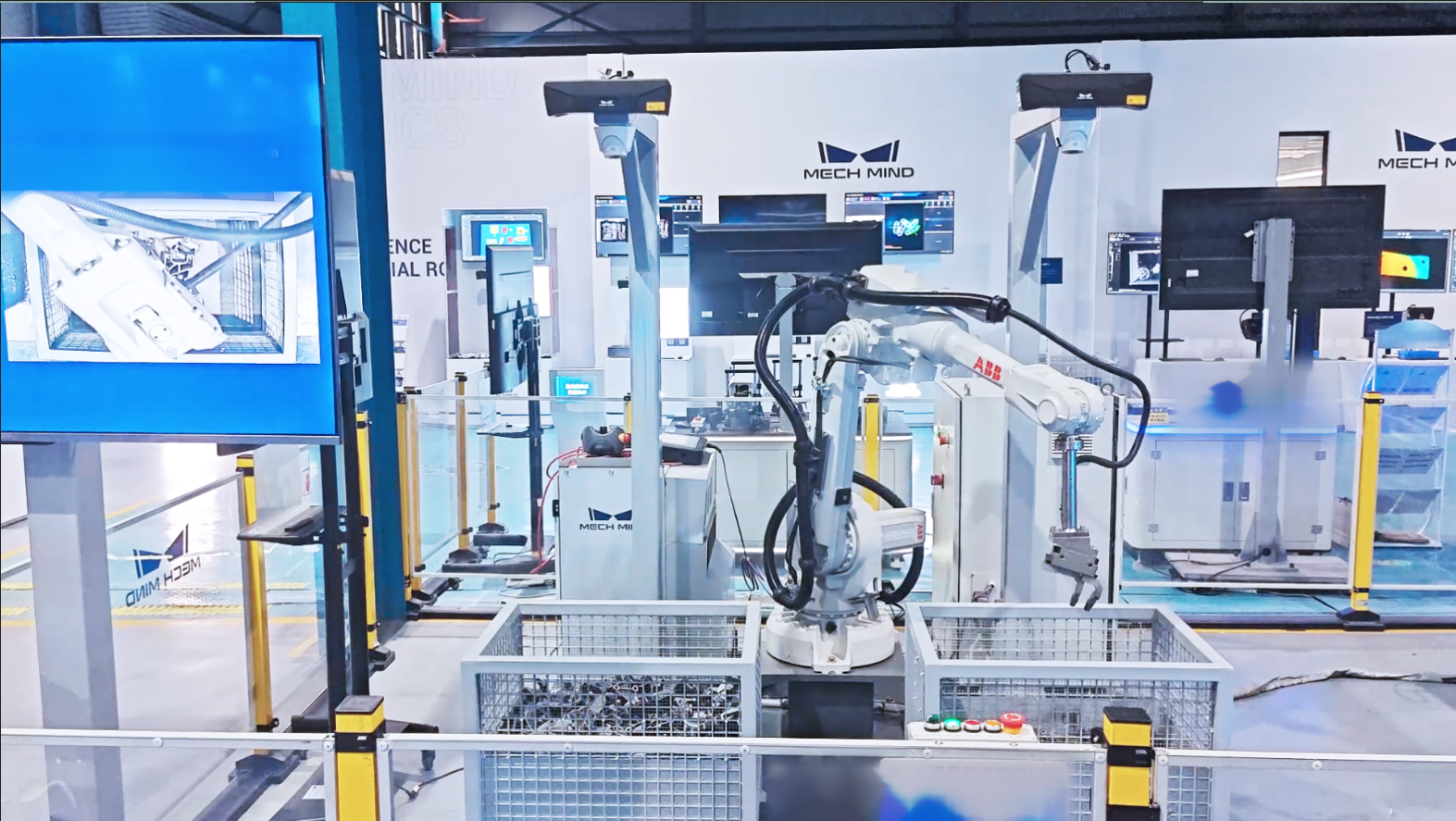
The company is not a robot-arm builder. Mech-Mind supplies the perception and decision layer that sits on top of third-party robot arms, mobile platforms and grippers, a software and algorithm stack it markets as a "brain, eyes and hands" for industrial robots: 3D cameras and sensors for perception, AI models for path and grasp planning, and control software that hands instructions to whichever arm the customer has already bought. Its core markets are bin-picking, palletizing and depalletizing, machine-tending, and inspection and measurement across manufacturing and logistics, the categories of work where parts arrive jumbled, reflective, transparent, or otherwise unpredictable enough that a fixed program breaks down. For the six months ended June 30, 2026, gross profit reached RMB154.2 million (approximately US$21.6 million), up 63.6% from RMB94.3 million (approximately US$13.2 million) a year earlier, and gross margin rose to 65.0% from 61.4%.
Order Growth Ahead of Revenue Is the More Useful Number
Revenue growth alone tells only half the story for a company three weeks into its public life; the number that matters more to a buyer trying to judge staying power is the order book behind it. New orders signed during the period totaled RMB335.4 million (approximately US$46.9 million), up 75.3% year on year, a growth rate that outpaced booked revenue and points to demand still building rather than plateauing. Order backlog at period end stood at RMB176.5 million (approximately US$24.7 million), up 102.0% from a year earlier, which means the pipeline feeding the second half of 2026 and into 2027 is already double the size it was twelve months ago.
The customer metrics reinforce that reading. Mech-Mind counts more than 1,600 customers cumulatively, including over 100 Fortune Global 500 companies, and its repurchase rate for the first half of 2026 reached 93.9%. A repurchase rate that high in industrial automation typically means customers who validate the technology on one production line then roll it out across additional lines and plants, which is a materially different buying pattern than one-off pilot deals that never scale. Cumulative deployments now exceed 30,000 units globally, and the company's guidance and inspection software is compatible with more than 1,000 robot arm models from over 40 hardware brands, a range that lets it sell into a customer's existing equipment rather than requiring a hardware swap.
Margin Expansion While R&D Spending Jumped Is the Structural Signal
Gross margin climbing to 65.0% while research and development spending rose 72.9% to RMB80.1 million (approximately US$11.2 million) from RMB46.3 million (approximately US$6.5 million) is the combination that separates a scaling software business from a services shop still pricing by the job. Mech-Mind's own disclosure puts gross margin at just 39.1% back in 2023, more than 25 percentage points below the current 65.0% figure, while selling expenses measured against revenue dropped over that same window, from 102.7% down to 38.5%. That is a textbook operating-leverage curve: fixed engineering and product cost spread across a larger, more standardized customer base, with distribution cost per dollar of revenue falling as the company stops reinventing each deployment from scratch.
The company's adjusted loss (a non-IFRS measure) narrowed to RMB52.5 million (approximately US$7.3 million) from RMB55.8 million (approximately US$7.8 million), even with the higher R&D outlay. A company that can absorb a near-73% increase in research spending and still shrink its loss is telling a buyer something concrete about unit economics: each incremental deployment is now cheaper to deliver than the last one, largely because deployment cycles that used to run months have been compressed to days through AI-driven configuration rather than manual, project-by-project engineering. That compression is the standalone insight worth isolating: in industrial robot vision, the deployment-time curve, not the sensor specification sheet, is what determines whether a vendor's gross margin can survive scaling past its earliest reference customers.
Two Business Lines, One Growing Faster Than the Other
Mech-Mind reports results across two segments. Embodied intelligent robotic guidance, the core bin-picking, palletizing and machine-tending business, generated RMB216.3 million (approximately US$30.3 million), up 49.9% year on year, and remains the large majority of revenue. AI inspection and measurement, a newer product line that applies the same 3D vision and AI stack to quality checks and dimensional measurement rather than manipulation, grew 128.4% to RMB21.1 million (approximately US$3.0 million), lifting its share of total revenue from 6.0% to 8.9%. The inspection segment is still small in absolute terms, but its growth rate more than double the core business is the evidence that the underlying perception platform generalizes to adjacent industrial use cases rather than being a single-application product dressed up as a platform.
Overseas Revenue Is Where the Valuation Case Gets Tested
Overseas revenue reached 41.9% of the total in the first half of 2026, up from 38.5% a year earlier, with 86.5% of that overseas revenue coming from developed markets in Europe, the United States, Japan and South Korea. From 2023 to 2025, overseas revenue grew from RMB58.6 million (approximately US$8.2 million) to RMB195.5 million (approximately US$27.3 million), a compound annual growth rate of 82.7%. The company has subsidiaries in Munich, Tokyo, Detroit and Seoul and says its business now covers nearly 50 countries and regions; it also disclosed that roughly 29.4% of net proceeds from the HKEX offering are earmarked for expanding that global footprint and accelerating overseas commercialization.
That geographic mix matters for a buyer's risk assessment independent of the headline growth numbers. A China-based vendor with more than four-fifths of its overseas revenue concentrated in developed, higher-labor-cost markets carries a different set of export-control and tariff exposures than one selling mainly into its home market. The company's framing, that developed markets combine higher labor costs, tighter hiring and faster population aging, is a reasonable case for durable demand there. It also assumes trade conditions between China and those markets stay roughly as open as today, an assumption no buyer should treat as guaranteed over a multi-year vendor relationship.
What a First Earnings Report Should Tell a Procurement Buyer
A newly listed vendor's first interim results carry a specific kind of evidentiary weight: they are the first numbers a customer can check against the pitch deck rather than take on faith. Three things here matter more to a buyer than the headline revenue growth rate. Order backlog growing faster than revenue suggests the sales pipeline is not being drawn down to flatter a debut report. The narrowing adjusted loss alongside rising R&D spending shows the company is not trading product investment against cash discipline, the trade-off that sinks vendors mid-contract when either engineering talent or runway runs short. And the 93.9% repurchase rate is a better predictor of long-term supportability than any single quarter's revenue, because a vendor customers keep buying from after the pilot phase is one still shipping firmware updates and spare parts in three years.
On competitive position, Mech-Mind sits in a different layer of the stack than pure 3D-sensor hardware makers such as RoboSense or Orbbec, which build cameras and lidar rather than the perception software and grasp-planning algorithms layered on top. Its compatibility claim, more than 1,000 arm models across 40-plus brands, matters more to a buyer than any sensor specification: it positions the company as hardware-agnostic middleware rather than a vertically integrated bundle, widening its addressable market while pushing its moat toward algorithms rather than proprietary hardware. The more direct long-term threat is not another vision-hardware vendor but systems integrators and large automation companies building comparable perception stacks in-house, a path some Fortune Global 500 customers are large enough to attempt themselves once a use case is proven. The self-developed dexterous hand, which the company says achieved a grasping cycle life of at least 2 million cycles against an industry norm of 100,000 to 300,000, is a specific, checkable claim that argues against that in-house-build threat, since it signals engineering depth most integrators would not replicate quickly.
The macro case Mech-Mind is making for itself rests on a data point worth stating plainly: the International Federation of Robotics (IFR) recorded 542,000 new industrial robot installations globally in 2024, against an industrial robot penetration rate the company puts at under 1% of addressable tasks. Whether or not that specific ceiling estimate holds up, the direction of the argument, that most factory and warehouse work still is not automated because conditions vary too much for rigid programming, is the same argument that has justified robot-vision investment for a decade. What is new here is a public company with audited interim numbers instead of a pitch deck making that case.
Founder, Chairman and Chief Executive Officer Shao Tianlan framed the results around restraint rather than promotion, saying the company would "continue to uphold the principle of 'no exaggeration, no falsification'" in reporting its progress. For a company three weeks into public markets scrutiny, that is as much a positioning statement to investors as it is a technology claim, and it is one the order backlog and repurchase-rate figures in this report largely support rather than contradict.
The verdict for a procurement or automation-sourcing team evaluating Mech-Mind is straightforward: this is a first earnings report that backs up the growth story with the specific metrics that predict vendor durability, backlog acceleration, narrowing losses despite higher R&D, and a repurchase rate above 93%, rather than resting on revenue growth alone. The risk worth pricing in is not product quality, which the deployment scale and customer roster already validate, but concentration risk in a China-domiciled supplier whose fastest-growing revenue now comes from developed markets where trade and technology policy can shift faster than any vendor relationship can be renegotiated.
This account synthesizes Mech-Mind Robotics' public statements and industry reporting on the September 24, 2026 announcement. It is for general information purposes only and does not constitute investment, financial, or legal advice.
Hero image credit: Mech-Mind Robotics.