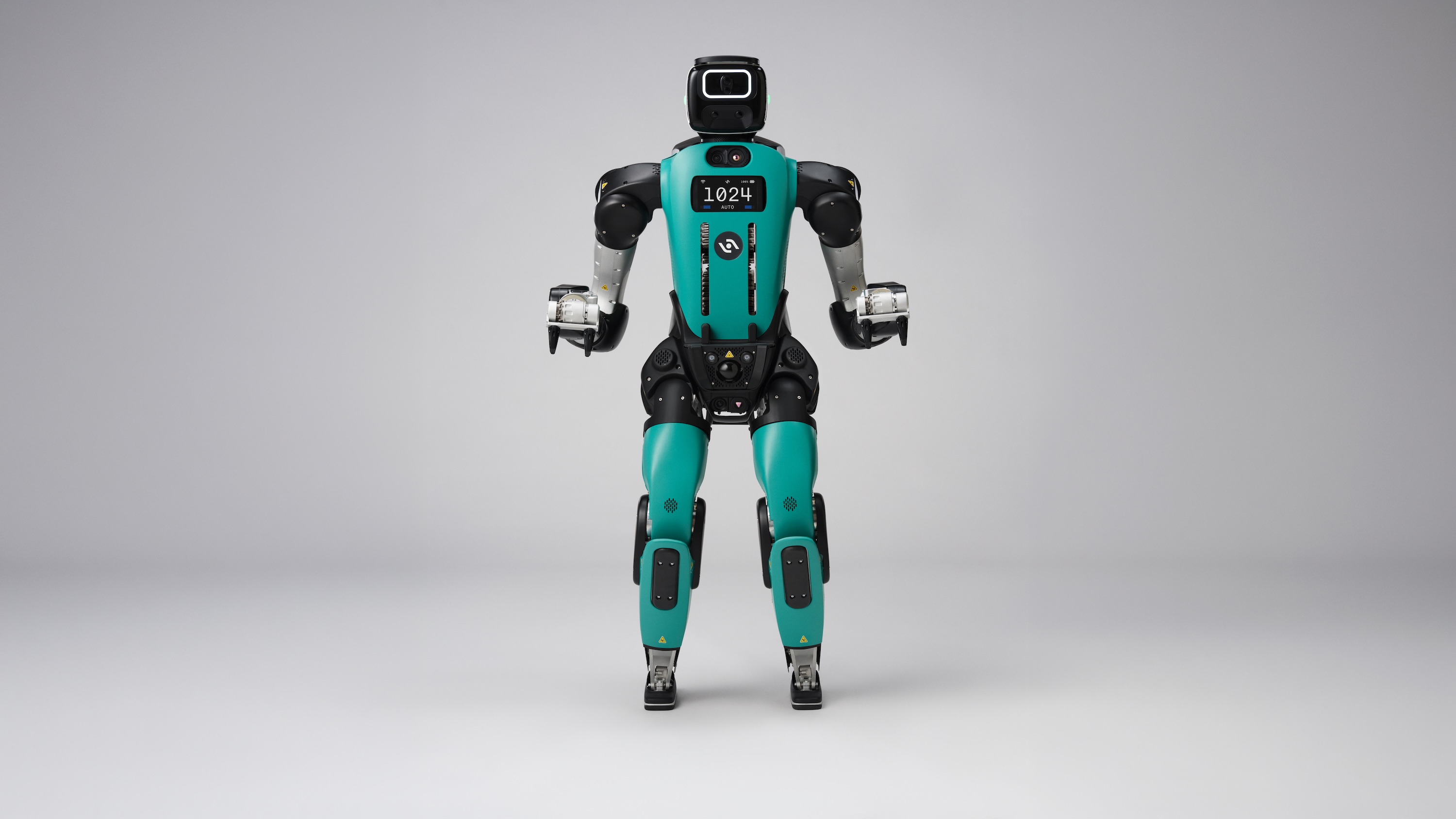
Korea's Surgical Humanoids Are Built to Replace Assistants, Not Surgeons
Samsung Medical Center put two humanoid robots beside a single surgeon for a ten-minute gallbladder procedure, a deliberate bet that hospitals will buy assistance rather than autonomy.

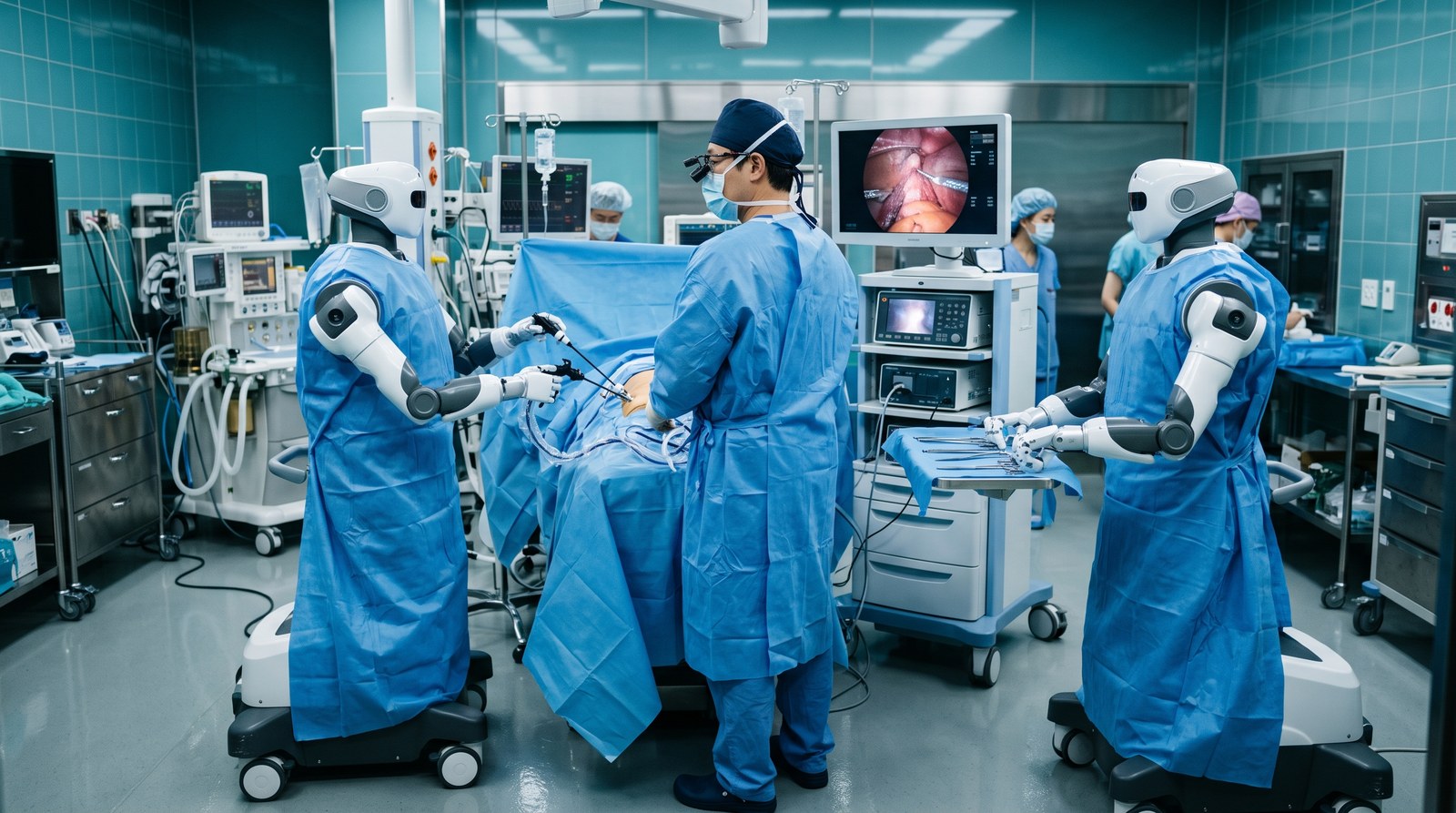
Korea has chosen a different target in the surgical robot race. Instead of building a machine that operates on its own, a state-funded consortium led by Samsung Medical Center has built two humanoid robots that do what residents and scrub nurses do, and it put them to work beside a single surgeon in front of an audience.
Samsung Medical Center demonstrated two humanoid surgical assistance robots working with one surgeon to remove a gallbladder from a goat liver in a little over ten minutes on 16 September 2026 in Gangnam District, Seoul. The robots handled instruments and camera work under voice command. The hospital described the result as the first divided-duty surgical team of its kind.
The robots wore blue surgical gowns and name tags identifying their roles as surgical assistant and surgical nurse. Oh Nam-kee, a professor of transplant surgery at Samsung Medical Center, led the procedure. One robot arm passed and retrieved scissors on request. Two arms on the other side held a laparoscopic camera and retracted tissue with forceps. Voice commands such as "Follow" moved the endoscope with the instrument, and the robots responded within roughly two seconds.
Two Robots, One Surgeon, Ten Minutes
The performance numbers matter more than the theatre. In testing, the robots picked up five types of surgical instruments with a 100 percent success rate and handed them over successfully 98.7 percent of the time. The hospital positions that band as close to human performance, which is a fair claim for instrument handling and an incomplete one for surgery.
The procedure itself, a cholecystectomy, was performed on a goat liver because the anatomy resembles a human liver closely enough for rehearsal. That choice defines both the achievement and its limits. Tissue that does not bleed unpredictably, a patient that cannot destabilise, and a room without time pressure remove most of the variables that make an operating room difficult. A 98.7 percent handover rate reads well on a slide and reads differently at the table, where roughly one exchange in seventy-seven fails while an incision is open.
The research team is explicit that clinical use is years out. Duties will expand gradually, starting with tasks as contained as repositioning an endoscope. The first clinical trial is targeted for 2029, with three hospitals lined up for procedures including gallbladder removal and pituitary tumour resection.
The Funding Is Small, and That Is the Strategy
The work sits inside the Korean Advanced Research Projects Agency for Health project, known as Korean ARPA-H, a government-funded health research and development programme with Samsung Medical Center as lead institution. The government plans to invest KRW 13.8 billion, approximately US$10 million, across five years from 2025 through 2029. The 16 September event presented interim results from the project's second year.
That budget is modest for a surgical robotics programme. Intuitive Surgical spends more than that on research and development in a matter of days. The gap explains the design philosophy rather than undermining it. A programme with US$10 million over five years cannot win a race to autonomous surgery against American and Chinese teams with far deeper funding, and it does not need to. Assembling commercially available Korean robot arms, grippers and force sensors into a role that hospitals already staff is a far cheaper problem, and the regulatory path is shorter because a human surgeon remains accountable for every clinical decision.
The global surgical robot market was valued at US$12.49 billion in 2025 and is projected to reach US$45.93 billion by 2034 according to Korean health industry data used by the project. The United States and China are widely treated as the leaders in that market. Korea is not attempting to lead it. It is attempting to own a layer inside it.
The Autonomous Lane Is Blocked by Liability, Not Capability
Two reference points frame Korea's choice. In July 2025, a Johns Hopkins University team in the United States reported an artificial intelligence guided surgical robot completing eight gallbladder removals on pig cadavers without human intervention. In January 2026, a Chinese case became public in which a robot carried out central steps of a bile duct operation on a pig without a surgeon driving it, tying off and dividing the duct on its own.
Both results are technically ahead of a robot that hands over scissors. Neither is close to a hospital purchase order. Yeo Jun-gu, program director of the K-Moonshot artificial intelligence humanoid project, framed the obstacle in terms buyers recognise, pointing to unresolved questions of responsibility when accidents occur and of control. Liability, not dexterity, is the binding constraint on autonomous surgery, and no software update resolves it.
An assistive robot changes the question a hospital's risk committee has to answer. It is the difference between buying a machine that makes clinical decisions and buying a machine that holds a camera steady for four hours without fatigue. The second purchase can be approved by a procurement committee. The first requires a legal framework that does not yet exist in any major market.
The Supply Chain Behind ORchestra Is Already Commercial
The system demonstrated in Seoul, developed under the project name ORchestra, is not a single vendor's product. Seven institutions contribute. Rainbow Robotics, the Daejeon-based manufacturer spun out of the Korea Advanced Institute of Science and Technology that builds collaborative arms and the RB-Y1 wheeled dual-arm platform, supplies the robot body. AIDIN Robotics, a Seongnam-based maker of force and proximity sensing hardware for robot arms, supplies the smart gripper and its AIDIN Hand Gen2 end effector. Artificial intelligence software comes from Sungkyunkwan University and Seoul National University. Data collection and validation run through the National Cancer Center and Jeonbuk National University Hospital.
That structure is the most transferable part of the story. Every component in the stack is a product that a systems integrator can already buy, and the intellectual property being created sits in the task models and the surgical data, not in a bespoke robot. It also means the programme's commercial output may reach the market through its suppliers before any hospital signs for a complete system.
The team highlights a practical advantage that procurement teams will price immediately: the robots can work without substantially rebuilding operating room layouts or replacing surgical instruments. Retrofit economics beat greenfield economics in every hospital capital budget, because an installation that requires reconstructing a theatre competes against the revenue that theatre generates while it is closed.
Hospitals Are Buying Staffing Relief, Not Robots
The clinical rationale is a workforce problem. Resident working hours in Korea have been cut while operations still require several people around the table, and regional hospitals carry the sharpest shortages. Jung Kyu-hwan, head of the Intelligent Medical Robotics Research Center at Samsung Medical Center, traced the research directly to field complaints that there are not enough surgical personnel. Jung Yong-gi, the professor of otorhinolaryngology leading the research, pointed to standardised surgical assistance at regional hospitals and during night and emergency cases as the intended outcome.
The commercial logic behind that phrasing is straightforward. A hospital cannot currently buy a resident. It can buy capital equipment, depreciate it, and schedule it. If two machines allow a single surgeon to run a procedure that previously required three trained people, the purchase is evaluated against salary lines and overtime, not against a robotics budget. That is a far easier case to win, and it is the same substitution logic that moved automation into warehouses before it moved into factories.
Korea's existing robotic surgery market shows where the friction will appear. Roughly 270 da Vinci systems from Intuitive Surgical are installed in the country and robot-assisted procedures account for approximately 16 percent of major surgeries, yet national health insurance still does not cover robotic surgery, which keeps costs with the patient. A successful assistive robot inherits that reimbursement question. A machine that replaces staff time rather than adding a billable procedure may in fact have an easier answer, because its value shows up as hospital cost avoidance rather than as a new patient charge.
The most valuable robot in an operating room may turn out to be the one that never touches the patient.
The timing places the demonstration inside a wider national push. Humanoids Summit Seoul opened on 22 September at the COEX convention centre in Seoul with official support from the Ministry of Science and Information and Communication Technology, and the Korea Institute of Science and Technology has publicly argued that the country can stand alongside the United States and China as a humanoid power. Medical robotics gives that argument a stronger commercial base than general-purpose humanoids do, because hospitals have identified budget lines, measurable staffing gaps and procurement cycles that do not depend on a machine becoming generally capable first.
What Buyers Should Watch Before 2029
Three markers will show whether this becomes a product. The first is task scope creep: if the robots move from endoscope positioning to retraction and suction under time pressure, the programme is on track. The second is the handover failure rate under live tissue conditions, which needs to improve by at least an order of magnitude before any surgeon signs off. The third is whether Rainbow Robotics and AIDIN Robotics convert project work into medical-grade product lines, because a research consortium cannot service a hospital fleet and a public company can.
Korea has made a defensible bet. The countries racing towards autonomous surgery are building the more impressive machine, and they will spend the next decade arguing with regulators about who is responsible when it fails. A robot that stands where a resident stands, hands over an instrument, and leaves every decision to the surgeon has a narrower ceiling and a much shorter path to an operating room.
This analysis synthesises hospital and project statements, disclosed test results, government funding allocations, supplier disclosures, and public market data available at the time of publication.
Disclaimer: This article is for informational purposes only and does not constitute investment, procurement, legal, or medical advice. Figures, specifications, funding amounts, and deployment timelines reflect information verified at the time of publication and may change.