
Ocado Secures European Automated Customer Fulfilment Centre Agreement
Ocado Group has signed an agreement to build a large automated Customer Fulfilment Centre for an unnamed European retailer, deploying its 600s bot and On-Grid Robotic Pick technology by FY2028.
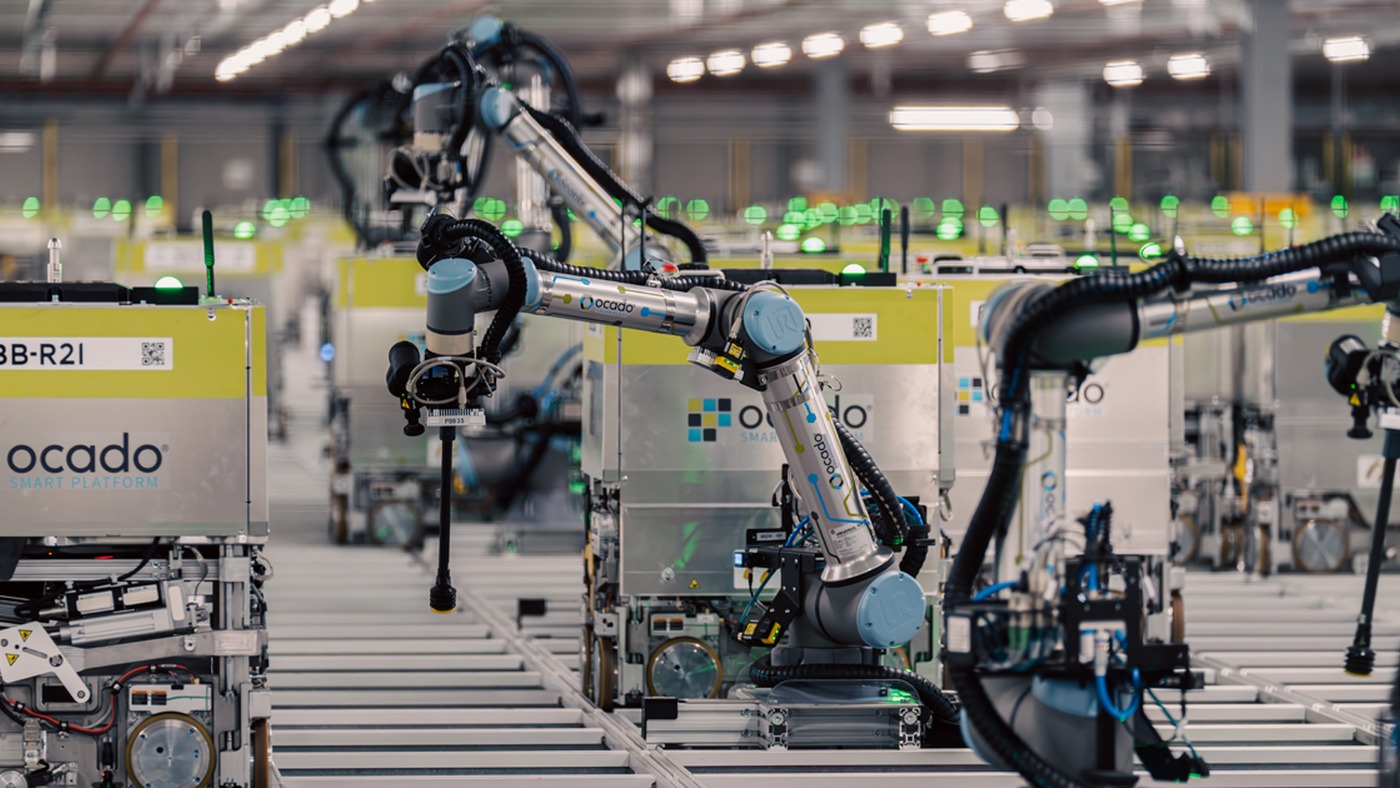
The viability of large scale, centralised robotic grocery fulfilment has secured a critical commercial validation in Europe. This agreement demonstrates that the economics of massive automation remain compelling when paired with guaranteed launch volume and next generation robotic picking capabilities. The broader logistics sector has closely monitored the performance of these massive facilities, waiting to see if the initial capital expenditure can be justified by long term operational efficiency. This new development provides a clear affirmative signal for the centralised model.
Ocado Group, the United Kingdom based technology provider whose automated grocery platforms have defined the modern Customer Fulfilment Centre (CFC), has signed a new agreement to build a large automated facility for an unnamed, fast growing European national retailer. Founded in 2000 and headquartered in Hatfield, England, Ocado Group initially operated as a pure play online grocer before pivoting to become a global technology provider, licensing its proprietary robotics and software platform to major supermarket chains worldwide. Its core technology revolves around massive grid based automated warehouses where swarms of robots retrieve grocery totes for human or robotic packing. The new facility is scheduled to go live in the 2028 financial year.
This agreement represents a significant operational milestone. Following decisions by Kroger in the United States and Sobeys in Canada to pause or close some of their automated facilities due to weaker than expected demand in less dense regions, the industry questioned whether the capital intensive CFC model could survive outside highly concentrated urban markets. This new European commitment demonstrates that for the right retail partner, the economics of centralised robotic picking remain compelling, provided the technological stack addresses the most acute labour pain points and the facility is supported by sufficient baseline volume.
What is the Ocado Re:Imagined CFC Agreement?
Ocado Group will install its Re:Imagined technology suite into a new automated Customer Fulfilment Centre for a European national retailer, scheduled to go live in the 2028 financial year. The facility features the 600s bot, On-Grid Robotic Pick technology, and a fully Automated Freezer to handle existing online order volumes.
The Shift to Next Generation Automation
The technological configuration of this new facility represents a maturation of the offering. The deployment of the Re:Imagined suite, specifically the 600s bot and the On-Grid Robotic Pick system, indicates a shift from merely automating the movement of totes to automating the actual picking process. This is a fundamental evolution in the architecture of grocery fulfilment. The previous generation of automation focused primarily on the storage and retrieval of bulk items, leaving the final selection to human operators. The new system addresses this final, most labour intensive step.
The 600s bot is significantly lighter and more energy efficient than its predecessors, allowing for lighter grid infrastructure and faster installation times. More importantly, the inclusion of On-Grid Robotic Pick means that robotic arms will handle the individual item picking directly from the grid, reducing the reliance on human pickers at decant stations. This is a crucial capability for European retailers facing structural labour shortages and rising wage inflation. The ability to automate the each pick, the selection of individual grocery items from a larger tote, has long been the holy grail of grocery logistics, and its inclusion in this commercial agreement signals that the technology is ready for scaled deployment.
additionally, the inclusion of a fully Automated Freezer addresses one of the most challenging environments in grocery logistics. Operating robotics reliably at sub zero temperatures eliminates one of the most difficult and undesirable human jobs in the warehouse, while also improving energy efficiency by minimising the opening of freezer doors. The technical difficulty of maintaining battery performance, sensor accuracy, and mechanical reliability in deep freeze conditions cannot be overstated, making this a significant competitive differentiator for the platform.
The Economics of Centralised Fulfilment
The strategic implications of this deal extend beyond the technology itself. The unnamed retailer plan to transfer existing online order volumes into the CFC immediately upon launch is a critical detail. By guaranteeing that the facility will open with a utilisation rate of just over half its design capacity, the retailer is mitigating the primary risk of the CFC model, the valley of death between capital expenditure and operational scale. This guaranteed volume provides the financial foundation necessary to support the massive upfront investment required for such a facility.
Centralised automated facilities require massive upfront investment. If they operate below a certain capacity threshold, the fixed costs overwhelm the unit economics. By bringing existing volume to the new site, the European retailer ensures that the facility will quickly reach the throughput necessary to justify the automation investment. This approach transforms the CFC from a speculative bet on future growth into a mechanism for consolidating and optimising existing demand.
This contrasts sharply with the challenges faced in North America, where partners sometimes struggled to generate sufficient online grocery demand in specific geographic catchments to fill the massive capacity of their CFCs. The European market, with its higher population density and more established online grocery habits, may provide a more forgiving environment for this scale of automation. The density of the customer base directly impacts the efficiency of the final mile delivery, which is the necessary counterpart to the centralised fulfilment model.
"Together with our agreement with Asda earlier this year, this partnership highlights the growing demand for our solutions across the breadth of our technology offering," stated Tim Steiner, Chief Executive Officer of Ocado Group.
Bridging the Gap Between Totes and Items
To understand why the On-Grid Robotic Pick is such a significant development, imagine a massive library where the books are stored in boxes. The traditional system is excellent at retrieving the correct box and bringing it to a librarian. However, the librarian still has to reach into the box, find the specific book, and place it in the reader bag. The On-Grid Robotic Pick system replaces the librarian. It uses advanced computer vision and robotic manipulation to reach into the box, identify the specific item, whether it is a rigid box of cereal or a deformable bag of frozen peas, and transfer it directly to the customer order. This eliminates the most labour intensive bottleneck in the entire process, fundamentally altering the cost structure of the facility. The integration of this technology represents a significant leap forward in the practical application of robotics in unstructured environments.
The Reality of Retail Automation
The narrative surrounding grocery automation often oscillates between the extremes of total micro fulfilment dominance and the absolute necessity of massive centralised hubs. The reality is far more nuanced. While there has been a recent pivot to promoting store based automation solutions, evidenced by the recent deal with Asda in the United Kingdom, this new European CFC agreement proves that the centralised model is not obsolete.
Instead, the market is segmenting. Micro fulfilment and store based automation serve immediate, hyper local demand, while large scale CFCs serve dense, high volume regions where the efficiency of On-Grid Robotic Pick and Automated Freezers can be fully realised. The European retailer commitment to a 2028 go live date indicates a long term strategic bet on the latter.
However, the prevailing assumption that micro fulfilment will inevitably replace centralised hubs ignores the fundamental physics of inventory management. Micro fulfilment centres, by definition, have limited space and can only hold a fraction of a full supermarket assortment. They are excellent for fast moving consumer goods but struggle with the long tail of grocery items. Centralised CFCs, conversely, can hold tens of thousands of Stock Keeping Units (SKUs), offering a superior customer proposition in terms of choice. The challenge has always been the cost of picking and the cost of delivery. By automating the each pick and deploying in dense European markets, the partners are betting that they can solve both sides of that equation.
The Operational Reality of Massive Infrastructure
For procurement managers and supply chain leaders, the lesson is clear. The choice of automation architecture must be dictated by the specific demand profile and existing volume of the target market, not by prevailing industry trends. The technology works, but the business case depends entirely on utilisation. A massive automated facility is only a competitive advantage if it is running near capacity; otherwise, it is merely an expensive monument to technological optimism. The ability to guarantee that baseline volume is the true differentiator in this agreement, providing a clear roadmap for future deployments.
When evaluating potential automation partners, procurement teams must look beyond the impressive demonstrations of robotic speed and focus on the reliability of the system under peak load conditions. The integration of the On-Grid Robotic Pick system introduces new variables into the maintenance and support contracts that must be carefully negotiated. The cost of downtime in a facility of this scale is astronomical, making robust service level agreements an absolute necessity.
additionally, the deployment of such a massive facility requires a level of project management expertise that is often underestimated. The coordination of civil engineering, mechanical installation, software integration, and operational testing is a monumental task. Retailers must ensure that their internal teams are adequately resourced and trained to manage the transition from legacy systems to the new automated platform.
The Battle for High Volume Fulfilment
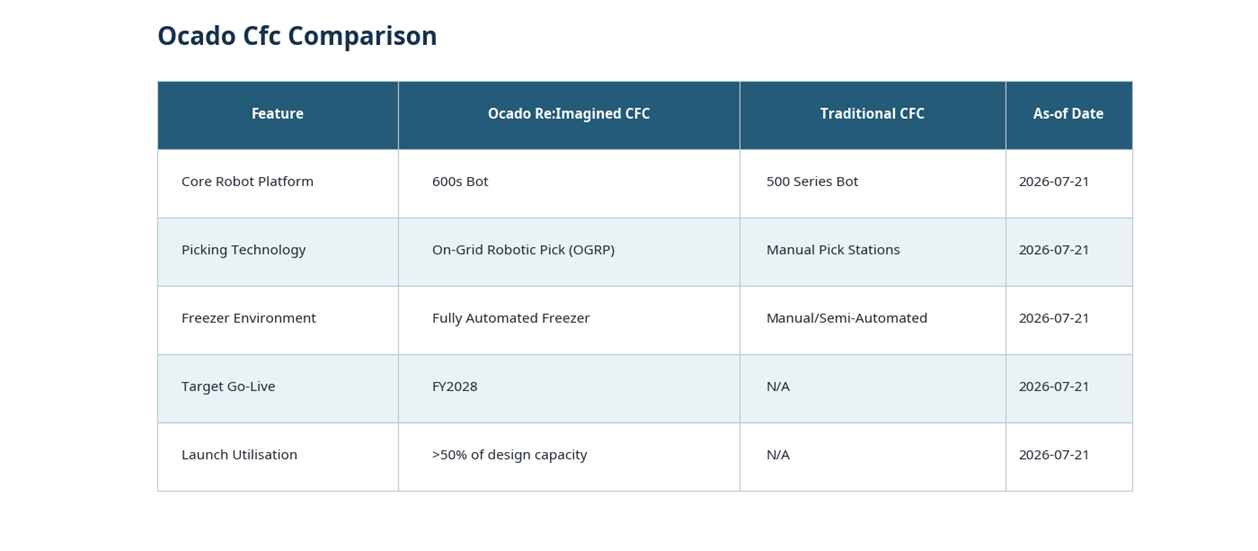
Comparison table. Source evidence and as-of dates are retained in the accompanying XLSX workbook.
The environment of grocery automation is highly competitive, with several major players vying for market share. While the Re:Imagined suite offers a comprehensive solution, it is essential to consider alternative approaches. AutoStore, a prominent competitor, utilises a similar grid based storage system but has historically focused more heavily on micro fulfilment and smaller scale deployments. Their system is highly modular and can be installed in existing retail spaces, offering a lower barrier to entry for some retailers. However, the massive scale and integrated picking capabilities of the new European CFC demonstrate a distinct advantage for high volume, centralised operations.
Another significant player is Swisslog, which provides a range of automated guided vehicles and robotic picking solutions. Their approach is often more flexible, allowing for the integration of various technologies to create a customised solution. While this flexibility is appealing, it can also lead to increased intricateity in system integration and maintenance. The fully integrated nature of the Re:Imagined suite, where the hardware and software are designed to work seamlessly together, provides a level of operational certainty that is highly valued by major retailers.
The Long Term Bet on Centralised Capacity
The commitment to a 2028 go live date provides a clear signal regarding the expected trajectory of the grocery automation market. It indicates that major retailers are willing to make long term, capital intensive bets on the technology, provided the business case is sound. This long lead time also highlights the intricate engineering and construction requirements of these facilities, suggesting that the barrier to entry for new competitors will remain high.
The inclusion of the Automated Freezer is another significant adoption signal. As the demand for frozen goods continues to rise, the ability to automate this challenging environment will become increasingly important. Retailers who can efficiently manage their frozen supply chain will gain a significant competitive advantage. The successful deployment of this technology in the new European CFC will likely spur further investment in automated cold storage solutions across the industry.
The Final Mile Delivery Constraint
The hard truth that many industry observers fail to acknowledge is that the success of a massive automated facility is not guaranteed by the sophistication of its robotics. The most advanced picking arms and the fastest transport bots are useless if the facility is not supported by a robust and efficient final mile delivery network. The cost of delivering groceries to the customer door remains the most significant challenge in the online grocery business. The centralised CFC model relies on the ability to consolidate orders and optimise delivery routes to offset the high fixed costs of the facility.
If the delivery network is inefficient, the savings generated by the automated picking process will be quickly eroded. This is why the density of the customer base is such a critical factor in the success of the CFC model. In highly concentrated urban markets, the delivery routes are short and the drop density is high, making the economics work. In less dense suburban or rural areas, the cost of delivery can easily overwhelm the operational efficiencies of the CFC.
The Future of the Centralised Model
The transaction is not expected to have a material financial impact in the 2026 financial year, as the company continues to target cash flow positivity in the second half of the year. The long lead time to the 2028 go live date underscores the intricate engineering and construction requirements of these facilities, but the commitment itself provides a crucial signal of confidence in the underlying technology.
The European agreement serves as a powerful validation of the centralised automated fulfilment model. It demonstrates that when paired with guaranteed launch volume and advanced robotic picking capabilities, the massive CFC remains a highly effective strategy for serving dense, high volume markets. The integration of the On-Grid Robotic Pick system and the Automated Freezer addresses the most acute labour challenges in the grocery industry, fundamentally altering the cost structure of the facility.
The choice of automation architecture must be dictated by the specific demand profile and existing volume of the target market. The technology works, but the business case depends entirely on utilisation. A massive automated facility is only a competitive advantage if it is running near capacity. The ability to guarantee that baseline volume is the true differentiator in this agreement, providing a clear roadmap for future deployments.
This development was verified through official regulatory filings and primary corporate announcements.
Disclaimer: This article is for informational purposes only and does not constitute investment, legal, safety, or procurement advice. Readers should independently verify specifications, certification scope, pricing, availability, regulatory obligations, and operational suitability with the relevant suppliers and authorities before making decisions.












