
KUKA Gains IEC 62443-4-2 Security Level 2 Certification
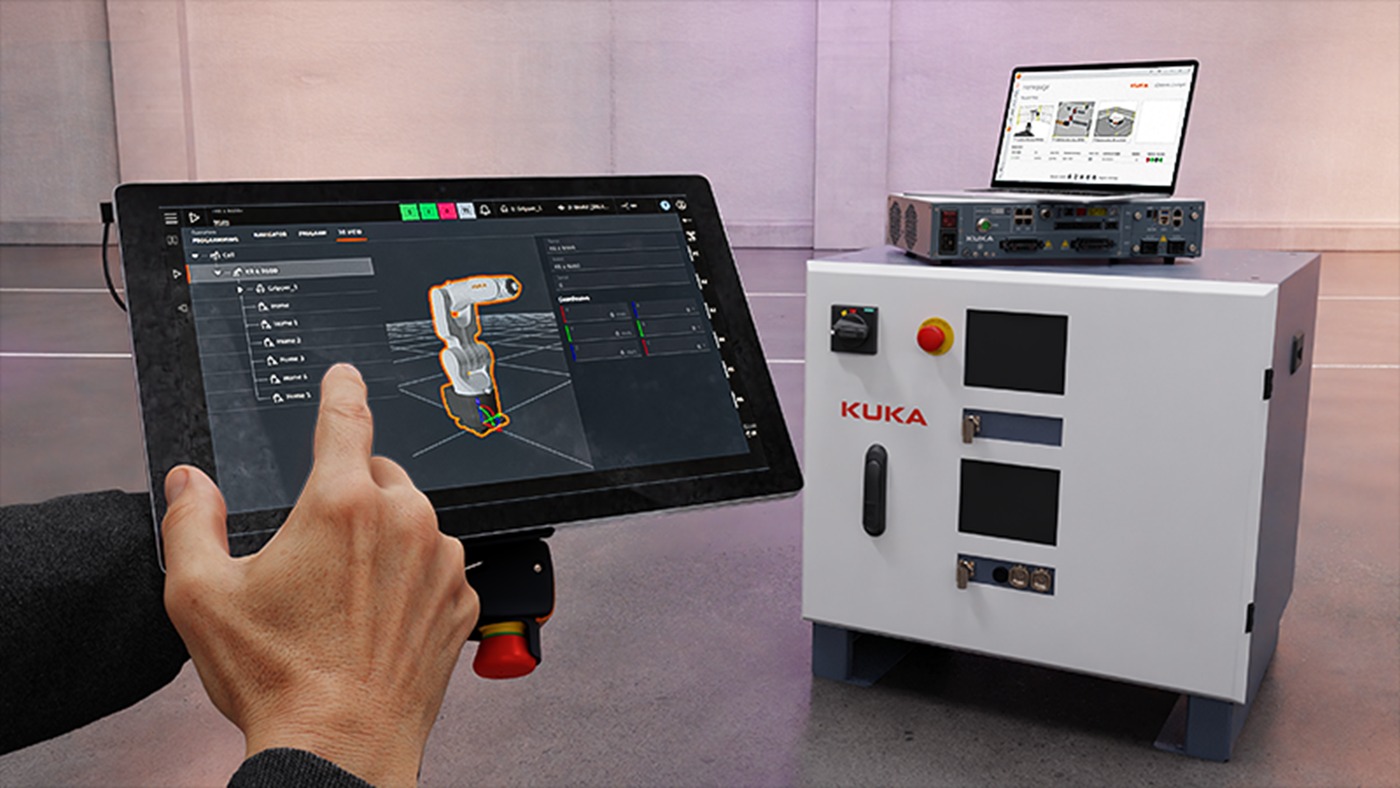
KUKA has become the first robotics manufacturer to achieve IEC 62443-4-2 Security Level 2 certification for its iiQKA.OS2 robot systems and KR C5 controller platform, addressing the growing procurement risk of industrial cybersecurity.
The Compliance Friction in Industrial Automation
The increasing connectivity of industrial production systems is fundamentally changing the requirements for automation. While functional safety used to be the main focus, digital control processes, data flows, and communication interfaces must now also be reliably protected. Production processes are becoming more digital, more connected, and increasingly software-controlled, often in company-owned, self-hosted environments. But as digitalization increases, so do the requirements for security and regulatory compliance. This creates a significant friction point for procurement managers and operations leaders who must balance the need for advanced automation with the strict requirements of industrial cybersecurity. The challenge is no longer just about how fast or accurately a robot can move, but how securely it can integrate into a networked production environment without exposing the entire facility to cyber threats. The integration of operational technology and information technology has dissolved the traditional air gaps that once protected factory floors, meaning that every connected device is a potential vector for intrusion. Consequently, the procurement process must evolve to treat cybersecurity not as an afterthought, but as a primary technical specification that carries as much weight as payload capacity or reach.
KUKA, headquartered in Augsburg, Germany, is a leading global supplier of intelligent automation solutions, specializing in industrial robots, autonomous mobile robots, and fully automated production systems. By securing this certification, KUKA is addressing a critical market niche: the need for highly secure, networked production environments where cybersecurity is a fundamental business requirement rather than an optional add-on. The company's core technology spans industrial robots, autonomous mobile robots, and fully automated production systems. The integration of these systems into modern manufacturing facilities requires a robust approach to security that goes beyond traditional perimeter defenses. As factories become smarter and more interconnected, the attack surface expands, making it imperative for individual components to possess inherent security capabilities. This shift in focus from network-level security to component-level security represents a fundamental change in how industrial automation is designed, deployed, and maintained. Procurement teams are increasingly recognizing that the cost of a security breach far outweighs the initial investment in secure components, driving a demand for certified products that can withstand the evolving threat environment.
What is IEC 62443-4-2 Security Level 2?
The IEC 62443 series of standards is the global benchmark for cybersecurity in industrial automation and control systems. Part 4-2 specifically defines the technical cybersecurity capability requirements for components. Achieving Security Level 2 means that the component has built-in capabilities to mitigate well-known attack scenarios and defend against simple, intentional attacks. This is a significant step up from Security Level 1, which only protects against coincidental or casual access. Security Level 2 requires the system to uniquely distinguish between individual users, authenticate itself to the overall system, provide tailored human role definitions, close inactive communication sessions, verify the source of communications, protect test interfaces, and ensure that code in execution comes from a trusted source.
The standard provides a comprehensive framework for assessing the security capabilities of industrial control systems, offering a structured approach to identifying and mitigating risks. By defining specific security levels, the standard enables organizations to align their security investments with their risk tolerance and operational requirements. Security Level 2 is particularly relevant for environments where the threat of intentional attacks is a realistic concern, but where the resources and sophistication of the attackers are limited. This level of security provides a robust defense against common attack vectors, such as unauthorized access, malware infections, and denial-of-service attacks. The certification process involves rigorous testing and evaluation by independent third-party organizations, ensuring that the component meets the stringent requirements of the standard. This independent verification provides procurement managers with the confidence they need to make informed purchasing decisions, reducing the reliance on vendor claims and marketing materials.
The Shift to Built-In Component Security
On July 21, 2026, KUKA announced that it became the first robotics manufacturer to achieve certification for Security Level 2 in accordance with IEC 62443-4-2 for its iiQKA.OS2 robot systems. This certification applies to the iiQKA.OS2 operating system and the KR C5 controller platform. The certification confirms that the iiQKA.OS2 system meets the stringent requirements of IEC 62443-4-2 Security Level 2. In addition to the cybersecurity certification, KUKA stated that the robot systems with iiQKA.OS2 already meet the requirements of Regulation (EU) 2024/2847 Cyber Resilience and fully comply with the requirements of EN ISO 10218-1:2025. This dual compliance provides a future-proof, standard-compliant basis for industrial applications, ensuring that safety functions such as Normal Stop, Restart Interlock, and the monitoring of all axes operate efficiently, reliably, and safely.
To understand the significance of this certification, it is necessary to look at what it actually proves. Achieving Security Level 2 means that the KUKA KR C5 controller and iiQKA.OS2 operating system have built-in capabilities to mitigate well-known attack scenarios. It proves that the component can defend against simple, intentional attacks, which is a significant step up from Security Level 1, which only protects against coincidental or casual access. The certification provides independent verification that the manufacturer has implemented specific technical controls, such as robust authentication mechanisms, secure boot processes, and encrypted communication channels.
However, it is equally important to understand what this certification does not prove. It does not guarantee that an entire factory or production line is secure. The certification applies specifically to the component level. A secure component must still be integrated into a secure network architecture and managed with robust operational security policies. Procurement managers must recognize that buying a Security Level 2 certified robot is only one part of a comprehensive industrial cybersecurity strategy. The durable value of this certification is that it provides a secure foundation, reducing the integration burden and compliance risk for the end-user. It shifts the responsibility for baseline component security from the system integrator back to the original equipment manufacturer.
The Economics of Procurement and Deployment
For sourcing managers and technology evaluators, the KUKA certification alters the baseline for vendor selection. When evaluating industrial robots for networked environments, the presence of IEC 62443-4-2 Security Level 2 certification provides a verifiable metric for cybersecurity readiness. It simplifies the due diligence process and provides assurance that the equipment meets recognized international standards. This is particularly relevant for companies that deliberately host and control their automation solutions themselves, where the burden of securing the network falls entirely on the internal IT and OT teams. By specifying Security Level 2 components, procurement teams can establish a higher minimum standard for their automation infrastructure, effectively filtering out suppliers who have not invested in robust cybersecurity capabilities.
The deployment implications are also significant. The iiQKA.OS2 operating system, combined with the KR C5 controller family, delivers a modern, high-performance system architecture. This architecture provides more intuitive operation, more efficient processes, and higher performance compared with previous controller generations. In addition, the close integration with the iiQWorks engineering platform enables end-to-end planning, simulation, and commissioning digitally and independently of physical hardware. This means that security configurations and compliance checks can be simulated and validated before the physical robot is even installed on the factory floor, reducing deployment time and minimizing operational disruption. The ability to model security policies in a digital twin environment represents a major advancement in how industrial control systems are deployed and maintained.
Translating Security Levels into Operational Reality
Think of Security Level 1 as a basic lock on a door. It keeps honest people out and prevents accidental entry, but it will not stop someone who is determined to get in. Security Level 2 is like adding a deadbolt, an alarm system, and a requirement to show ID before entering. It provides protection against someone who is actively trying to breach the system using common tools and techniques. In the context of industrial automation, this means the robot controller can actively verify who is trying to access it, ensure that the commands it receives are legitimate, and protect its internal software from unauthorized modifications. This level of security is essential when robots are connected to broader factory networks and cloud-based management systems. It ensures that even if a network perimeter is breached, the individual robotic components possess the resilience to resist unauthorized control or data exfiltration.
The practical application of these security measures involves a combination of technical controls and operational procedures. For example, the requirement to uniquely distinguish between individual users necessitates the implementation of robust identity and access management systems. This ensures that only authorized personnel can access the system, and that their actions can be tracked and audited. Similarly, the requirement to verify the source of communications requires the use of secure protocols and encryption mechanisms, protecting data in transit from interception and tampering. By translating these technical requirements into operational reality, organizations can establish a comprehensive security posture that protects their critical assets and ensures the continuity of their operations.
The Operational Risk of Bolted-On Security
The common narrative in industrial automation is that adding cybersecurity features inherently slows down performance and complicates operations. The hard truth is that failing to integrate cybersecurity at the component level creates far greater difficulty and operational risk during deployment. When procurement teams purchase equipment without built-in security capabilities, the burden of securing that equipment falls entirely on the system integrators and the facility's network architecture. This often leads to fragile, bolted-on security solutions that are difficult to maintain and prone to failure. By embedding Security Level 2 capabilities directly into the iiQKA.OS2 operating system and KR C5 controller, KUKA is shifting the security burden back to the manufacturer, providing a more robust and manageable solution for the end-user. This approach acknowledges that cybersecurity must be a foundational element of the product design, rather than an afterthought applied during the integration phase.
The reliance on bolted-on security solutions introduces a number of operational challenges. These solutions are often difficult to configure and manage, requiring specialized expertise that may not be readily available within the organization. In addition, integrating separate security products can create compatibility issues and performance bottlenecks, impacting the overall efficiency of the production system. In contrast, built-in security capabilities are designed to work seamlessly with the underlying hardware and software, minimizing the impact on performance and simplifying the management process. This integrated approach provides a more resilient and reliable security posture, reducing the risk of operational disruptions and ensuring the long-term viability of the automation investment.
Vendor Selection and Market Positioning
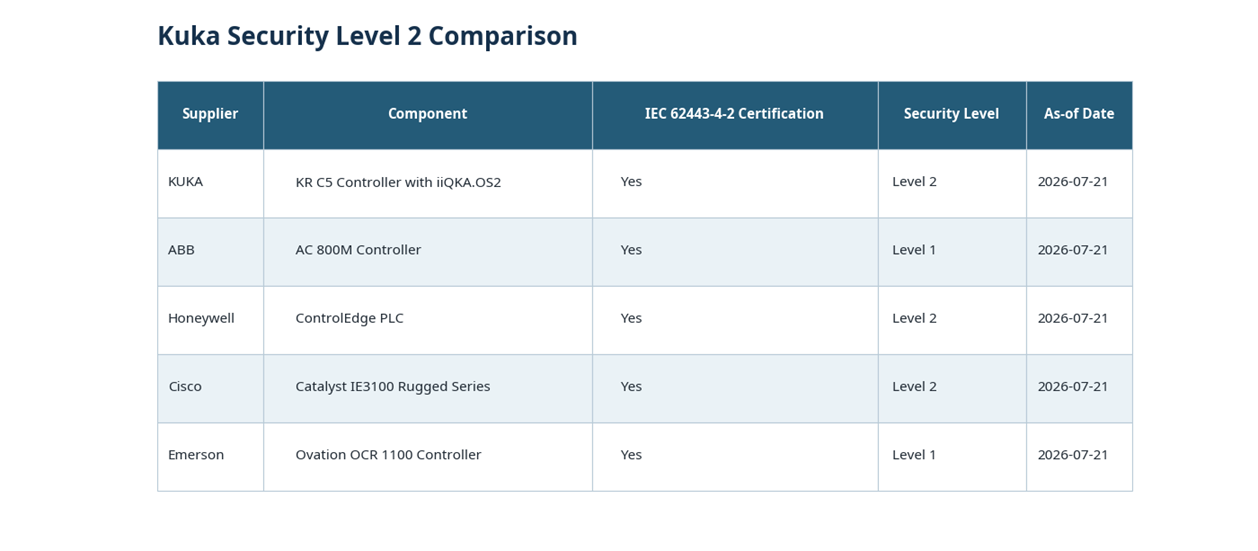
Comparison table. Source evidence and as-of dates are retained in the accompanying XLSX workbook.
The industrial robotics market is highly competitive, and cybersecurity certification is becoming a key differentiator. While KUKA is the first robotics manufacturer to achieve IEC 62443-4-2 Security Level 2 for its robot systems, other major players in the industrial automation space have also pursued certification for their control components.
This comparison highlights that while Security Level 1 is common among major automation suppliers, achieving Security Level 2 is a more exclusive tier. KUKA's achievement positions it strongly against competitors, particularly in sectors where regulatory compliance and data security are paramount. It is important to note that while companies like Honeywell and Cisco have achieved Security Level 2 for their programmable logic controllers and network switches, KUKA's certification specifically covers its robot systems and controller platform, marking a significant milestone for the robotics sector specifically.
The competitive field is changing rapidly, with vendors increasingly recognizing the importance of cybersecurity as a strategic differentiator. As more organizations prioritize security in their procurement decisions, the demand for certified components is expected to grow significantly. This trend will likely drive further innovation and investment in industrial cybersecurity, leading to the development of more advanced and resilient automation solutions. Vendors that fail to adapt to this changing market risk losing market share to competitors that can demonstrate a commitment to security and compliance. The KUKA certification serves as a catalyst for this transformation, setting a new benchmark for the industry and challenging other manufacturers to elevate their security capabilities.
The New Baseline for Automation Investments
"Cybersecurity is no longer an add-on topic today, but a central requirement for robust, future-ready production systems." This insight from KUKA underscores the structural shift occurring in industrial automation. The integration of cybersecurity directly into the robot operating system and controller hardware is not just a technical upgrade; it is a strategic necessity. As production environments become more connected and reliant on data flows, the ability to secure those connections will dictate the pace of automation adoption. Companies that fail to prioritize cybersecurity at the component level will increasingly find themselves excluded from critical supply chains and high-value manufacturing projects.
The KUKA IEC 62443-4-2 Security Level 2 certification is a clear signal that the robotics industry is maturing. It demonstrates a move away from isolated, functionally safe machines toward integrated, cyber-secure production nodes. For procurement managers and operations leaders, this development provides a new standard by which to evaluate automation investments. The focus must shift from merely assessing mechanical capabilities to evaluating the comprehensive security architecture of the proposed solution. The long-term implication is that cybersecurity certification will transition from being a competitive advantage to a mandatory prerequisite for participation in the modern industrial economy.
The transition to a more secure industrial environment requires a collaborative effort between manufacturers, system integrators, and end-users. Manufacturers must continue to invest in the development of secure components, while system integrators must ensure that these components are deployed in a secure and compliant manner. End-users, in turn, must prioritize security in their procurement decisions and establish robust operational policies to protect their critical assets. By working together, these stakeholders can create a more resilient and secure industrial ecosystem, enabling the safe and efficient adoption of advanced automation technologies. The KUKA certification represents a significant step forward in this journey, providing a tangible example of how built-in security can enhance the value and reliability of industrial control systems.
This article is based on verified claims from KUKA's official press release and the ISASecure certification registry.
Disclaimer: This article is for informational purposes only and does not constitute investment, legal, safety, or procurement advice. Readers should independently verify specifications, certification scope, pricing, availability, regulatory obligations, and operational suitability with the relevant suppliers and authorities before making decisions.












