DESCRIPTION
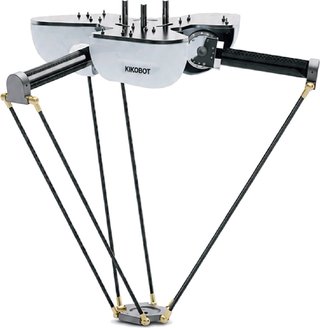
Kikobot DI Series est un Delta-Robot de Kikobot. Il est conçu pour Food-Handling, Packaging, Pick-and-place. Chiffres clés : 20 kg, 2 kg de charge utile, 3 degrés de liberté.
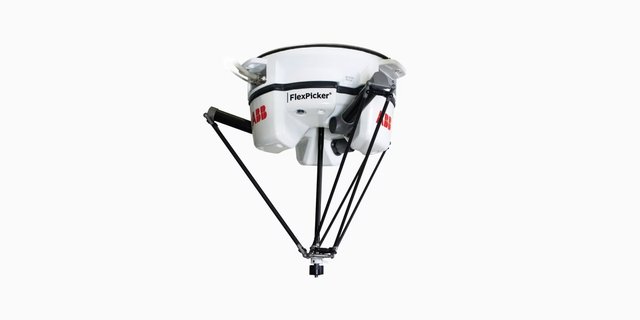
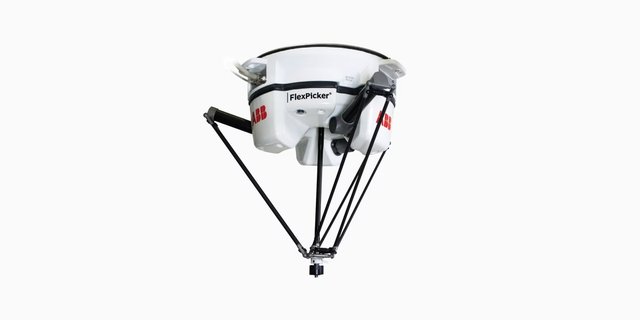
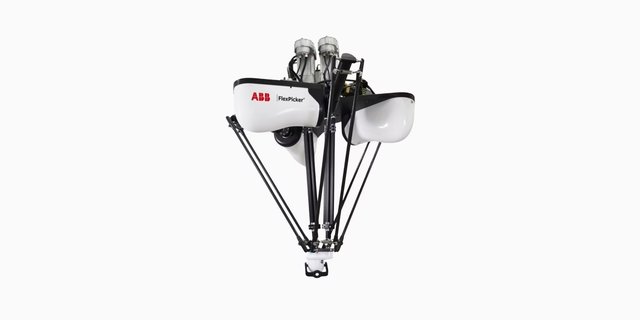
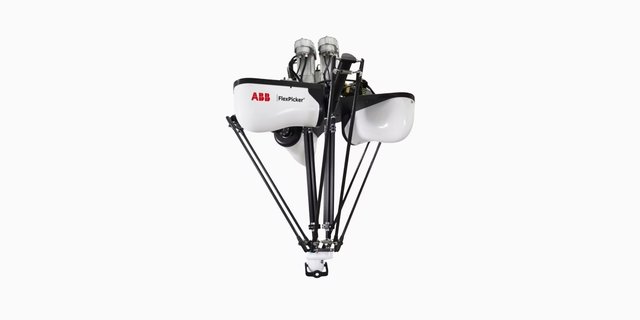
The DI Series is Kikobot's range of delta (parallel-arm) robots for fast, light pick-and-place work. The robot hangs above a conveyor or work area and moves a small end-effector with three carbon-fibre arm sets, sorting, picking and packing products for food and FMCG, electronics and consumer-goods lines. Two models are offered. The DI500 covers a working area 500 mm across and 220 mm deep, and the DI1000 covers 1,000 mm across and 350 mm deep. Both carry up to 2 kg, reach up to 120 cycles per minute and repeat positions to within 0.5 mm. The base configuration has three degrees of freedom, with four- and five-axis variants. Each robot weighs about 20 kg, has a mild-steel and aluminium body, mounts overhead and is rated for 0 to 80 degrees C. The controller uses EtherCAT, has 16 digital inputs and 16 outputs and runs from 100-240 V AC. Robots are programmed in Kikobot Delta Studio, which handles visual programming, cycle-time simulation, I/O set-up and conveyor tracking, and links to PLCs and vision systems.
FONCTIONNALITÉS
- Delta (parallel) robot series: DI500 and DI1000
- 3 degrees of freedom
- 4- and 5-axis variants
- Payload 2 kg
- Workspace DI500 diameter 500 x 220 mm
- DI1000 diameter 1,000 x 350 mm
- Repeatability +/-0.5 mm
- Up to 120 cycles per minute
- Weight approx. 20 kg
- Overhead mounting
- Body mild steel and aluminium
- carbon-fibre arms
- EtherCAT communication
- 16 DI / 16 DO
- Power input 100-240 V AC, 50/60 Hz
- Operating temperature 0-80 deg C
- Kikobot Delta Studio: visual programming, simulation and cycle-time estimation, I/O configuration, conveyor tracking
- Integrates with PLCs, vision systems, grippers and conveyors
- Applications: pick and place, sorting, packaging, food and FMCG, electronics, inspection, research and education
CARACTÉRISTIQUES TECHNIQUES
Vérifié| Physique | |
| Poids | 20 kg |
|---|---|
| Charge utile | 2 kg |
| Répétabilité | ±0.5 mm |
| Matériaux | Mild steel, Aluminium, Carbon fibre (arms) |
| Mobilité | |
| Type de déplacement | Stationary |
| Degrés de liberté | 3 |
| Environnement | Indoor production lines over conveyors, 0-80 deg C, 0°C to 80°C |
| Perception et calcul | |
| Connectivité | EtherCAT; 16 DI / 16 DO |
| Logiciel / IA | Kikobot Delta Studio (visual programming, simulation, conveyor tracking) |
FORUMS DU ROBOT
Chargement des forums...
CARACTÉRISTIQUES TECHNIQUES
Vérifié| Physique | |
| Poids | 20 kg |
|---|---|
| Charge utile | 2 kg |
| Répétabilité | ±0.5 mm |
| Matériaux | Mild steel, Aluminium, Carbon fibre (arms) |
| Mobilité | |
| Type de déplacement | Stationary |
| Degrés de liberté | 3 |
| Environnement | Indoor production lines over conveyors, 0-80 deg C, 0°C to 80°C |
| Perception et calcul | |
| Connectivité | EtherCAT; 16 DI / 16 DO |
| Logiciel / IA | Kikobot Delta Studio (visual programming, simulation, conveyor tracking) |
Images
 martti

Contributions d'images
Vidéos
FORUMS DU ROBOT
Chargement des forums...
NOTES
QUESTIONS FRÉQUENTES
What is the Kikobot DI Series?
The DI Series is Kikobot's range of delta (parallel-arm) robots for fast, light pick-and-place work. The robot hangs above a conveyor or work area and moves a small end-effector with three carbon-fibre arm sets, sorting, picking and packing products for food and FMCG, electronics and consumer-goods lines.
Who makes the Kikobot DI Series?
The Kikobot DI Series is made by Kikobot, a robotics company based in India.
How much does the Kikobot DI Series cost?
Kikobot has not publicly announced pricing for the Kikobot DI Series. You can enquire through RobotAIGeek for current pricing.
What is the Kikobot DI Series used for?
The Kikobot DI Series is designed for food-handling, packaging, pick-and-place, and sorting. It is used in electronics, warehouse & logistics, manufacturing, and restaurants & f&b settings.
What is the payload capacity of the Kikobot DI Series?
The Kikobot DI Series has a payload capacity of 2 kg.
How much does the Kikobot DI Series weigh?
The Kikobot DI Series weighs 20 kg.
How many degrees of freedom does the Kikobot DI Series have?
The Kikobot DI Series has 3 degrees of freedom.
COMPARER AVEC DES ROBOTS SIMILAIRES
Voyez comment ce robot se positionne face à ses alternatives les plus proches
- Kikobot DI Series vs Neuromeka D3
- Kikobot DI Series vs Neuromeka D6
- Kikobot DI Series vs ASPINA Delta Robot
- Kikobot DI Series vs PWR delta robot
- Kikobot DI Series vs IRB 1100-4/0.58