What Southeast Asia Actually Needs From AI Robotics
While the global robotics narrative often focuses on high-wage Western markets or China's rapid automation, Southeast Asia presents a unique and massive opportunity. As the region absorbs billions in manufacturing foreign direct investment, its specific needs—driven by eroding labor cost advantages and targeted industrial policies—demand a different class of robotics solutions. This article maps the real demand signals across ASEAN, from electronics assembly in Vietnam to agricultural automation in Malaysia.
The global supply chain is undergoing a historic realignment, and Southeast Asia is its primary beneficiary. Driven by the China plus one strategy and geopolitical hedging, massive volumes of foreign direct investment are flowing into the Association of Southeast Asian Nations. In 2024, foreign direct investment inflows to the region reached an impressive $226 billion, demonstrating remarkable resilience and growth. This influx is rapidly transforming the region into a global manufacturing powerhouse, particularly for electronics and semiconductors.
However, this manufacturing boom is colliding with a shifting labor reality. The traditional advantage of Southeast Asia, which is abundant, low cost labor, is beginning to erode. In Vietnam, for example, manufacturing wages have grown steadily, altering the economic calculus for labor intensive assembly operations. This convergence of increased manufacturing complexity and rising labor costs has brought the region to a critical inflection point for automation.
Yet, despite the massive industrial capacity being built, robot adoption in Southeast Asia remains remarkably low compared to East Asian neighbors. While South Korea and Singapore boast the highest robot densities globally, the broader region lags significantly. This gap represents one of the most substantial, untapped markets for robotics globally, but capturing it requires understanding what the region actually needs, rather than simply exporting solutions designed for Detroit or Shenzhen.
The Electronics and Automotive Imperative
The demand for robotics in Southeast Asia is not monolithic; it is highly segmented by country and industry, driven by specific local challenges and government initiatives.
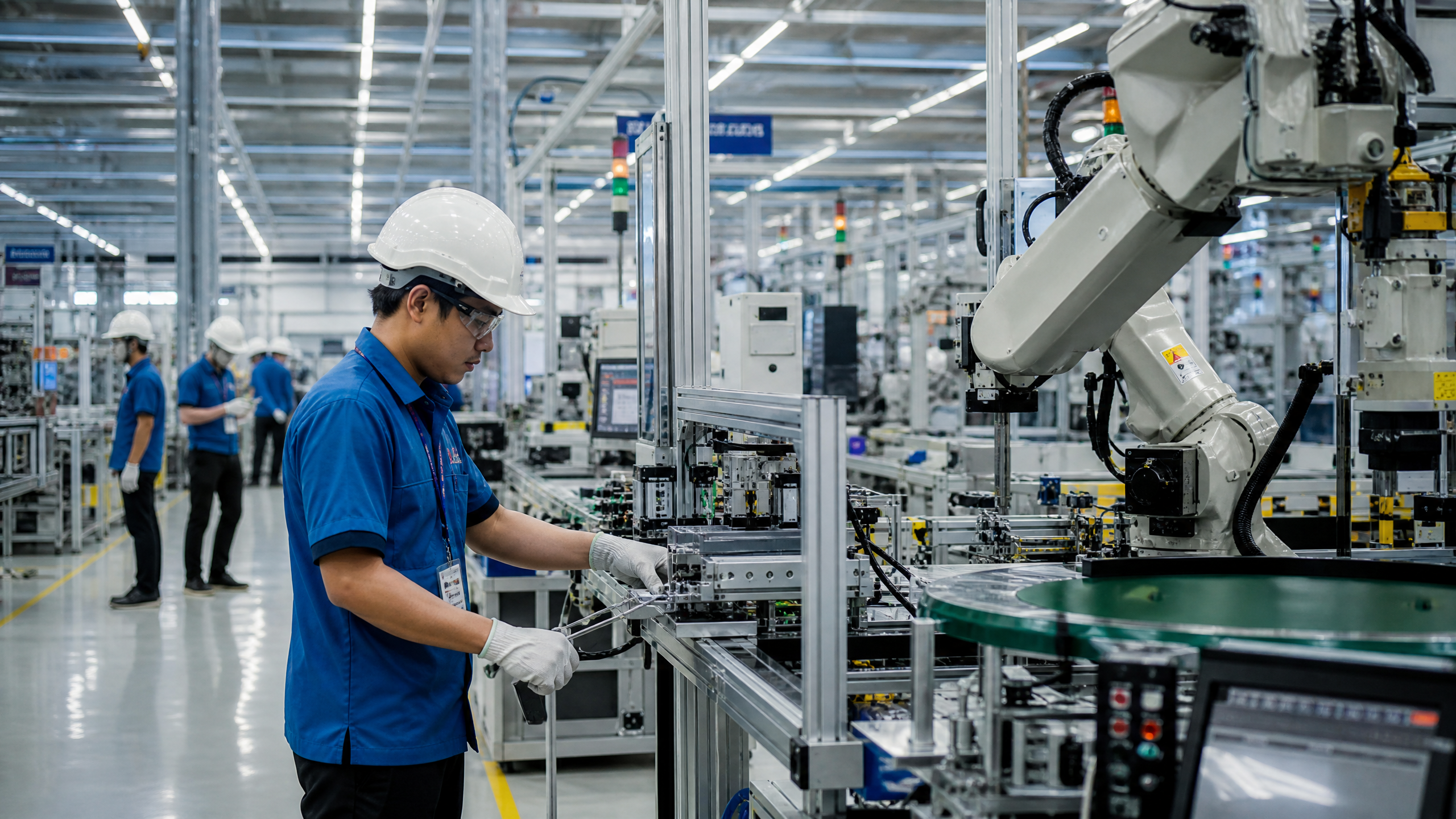
Vietnam has become the epicenter for electronics assembly, attracting massive investments from global technology giants. The requirement here is for high precision, high speed automation capable of handling delicate components. Collaborative robots that can work safely alongside human operators in dense assembly lines are particularly valuable.
The World Bank has highlighted the positive impact of this transition, noting that rapid robot adoption in Vietnam's high value added manufacturing industries created 255,000 high skilled jobs between 2018 and 2022. This underscores that automation in this context is often about upgrading capabilities and quality control rather than pure labor replacement.
Thailand, long established as the Detroit of Asia, is aggressively pursuing a smart factory agenda to maintain its automotive manufacturing edge, particularly as it transitions toward electric vehicle production. The Thai government's initiatives are designed to accelerate industrial upgrades, driving demand for robust industrial robotics, automated guided vehicles, and advanced machine vision systems for quality inspection.
Agricultural and Logistics Automation
In Malaysia and Indonesia, the demand profile shifts significantly. Both nations are dominant players in the global palm oil industry, a sector facing chronic labor shortages and intense pressure for sustainability and traceability. The response is a push toward agricultural robotics, including autonomous harvesting technology, robot dogs for fruit gathering, and precision application systems. This environment demands ruggedized, mobile robotics capable of navigating unstructured outdoor terrain, a stark contrast to the clean room requirements of electronics assembly.
Simultaneously, the explosive growth of e commerce across the region, particularly in Indonesia, is driving intense demand for logistics and warehouse automation. The requirement here is for high throughput sortation systems, autonomous mobile robots for goods to person picking, and increasingly, flexible robotic manipulation for piece picking tasks.
The Opportunity of Automation
The urgency of this transition is underscored by the potential impact on the existing workforce. The International Labour Organization estimates that nearly 80 million workers across the region are in jobs exposed to automation and generative AI. While this presents a significant societal challenge, it also highlights the massive scale of the automation opportunity.
For robotics vendors, particularly those from China, Japan, and South Korea who are aggressively positioning themselves in the region, success in Southeast Asia requires a tailored approach. The market demands solutions that fit mid market factory budgets and offer clear, rapid return on investment in environments where labor costs, while rising, are still lower than in the West. This favors flexible, easily redeployable systems and innovative financing models, such as Robot as a Service, which lower the barrier to entry for small and medium sized enterprises.
Southeast Asia does not need robotics designed solely for labor substitution in high wage economies. It needs robotics designed for capacity augmentation, quality enhancement, and operation in specific, challenging environments like tropical agriculture. The vendors who understand and build for these specific regional realities will capture the defining growth market of the next decade.
This analysis synthesizes company statements and public market activity.