POSCO Contract Tests a Robot on the Last Manual Gap
DGIST spin-off MFR won a POSCO award to place spacers between heavy plates, a shipping-yard task still done by people beside multi-ton loads.

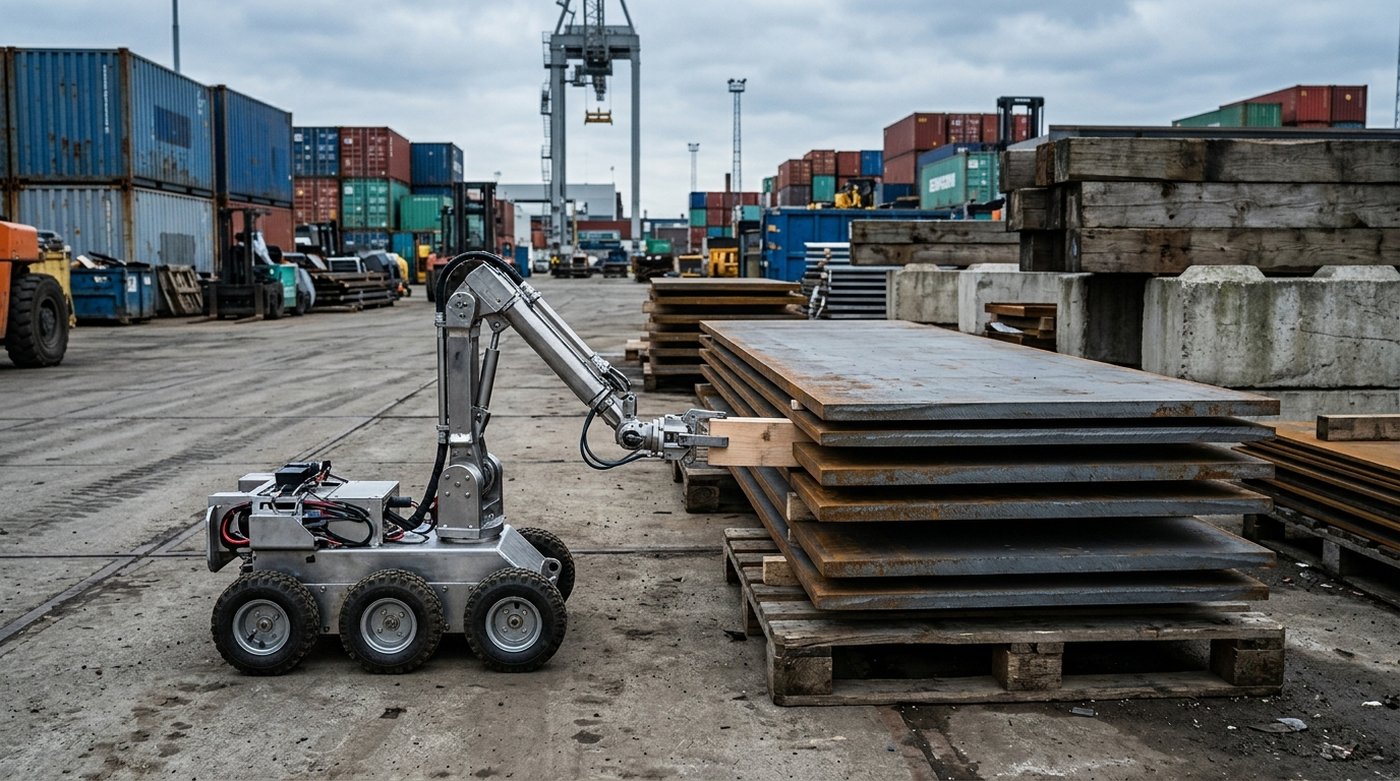
On 2 October 2026, DGIST said its spin-off MFR had won the final supply award for an unmanned robot that will insert spacers between heavy plates in a POSCO shipping yard. The award covers development and supply of that device. It is not a claim that the robot is already on shift.
The hazard sits in the gap, not the plate
Heavy plate leaves a mill in stacks. Each plate has to be separated so a crane, a truck, or the next handler can get a purchase. The separator is a spacer, and the person who places it stands where multi-ton plate is moving. ETNews, reporting DGIST's disclosure, describes collision and falling-object risk on the ground and fall risk for anyone working above the stack. Herald Business, in an English report of the same announcement, adds that the work happens in a shipping yard rather than on the rolling line.
That distinction matters. Plate rolling is already a mechanized process. The shipping gap is a leftover manual step, repeated often enough to be a safety case and awkward enough that a fixed arm cannot simply be bolted to the floor. MFR's answer, as both outlets describe it, is a mobile machine: sensor fusion for driving through the warehouse, then a 3D-vision arm that reads the stack and places the spacer. A variable lift and multi-axis control are what let it reach heights the company says workers should not have to climb. Automatic charging and wireless monitoring are meant to keep the operator outside the bay.
MFR chief executive Lee Seung-ryeol told the Korean reports that meeting POSCO's safety and technical bar put the project in the last stage before field use. The company is still building the equipment and tuning it to the site. No unit count, contract value, plate thickness, or cycle time was published. Treating the award as a deployed fleet would overstate what DGIST announced.
A contract is a filter, not a market
POSCO does not buy novelty. A supplier that clears a plate-mill safety review has already answered questions that a demo video never faces: who stops the machine, how it behaves when a plate is out of square, and whether a failed sensor sends it back to a dock instead of into a stack. That filter is the commercial fact in this story. The robot itself is still pre-deployment.
MFR is a researcher-founded firm at the Daegu Gyeongbuk Institute of Science and Technology, and its public site describes multi-purpose field robots for construction tasks, not a steel product line. The POSCO job is therefore a beachhead, and the company says it wants to carry the same pattern into other heavy-load and elevated work, then into other mills at home and abroad. Those are intentions. They are not orders.
For buyers outside Korea, the useful comparison is not humanoid dexterity. It is whether a dull, repeated, high-consequence insert can be handed to a mobile arm without inventing a new plant layout. Fixed automation lost this task because the stack moves and the gap is never in the same place. A mobile arm with onboard vision is the expensive way to accept that mess. If the POSCO trial holds, the export case is other plate yards with the same leftover manual step, not a general claim about steelmaking.
What the award does not yet prove
Read the Korean wording closely. ETNews says MFR received the final supply award for a project whose name is the development of an automated device that places spacers between heavy-plate products in warehouse shipping. Herald Business uses "contract" and "final stage before actual deployment." Both can be true. A final award inside a development project is not the same document as an acceptance test on a running bay. DGIST's own language, carried by both outlets, puts equipment manufacture and site-fit work still ahead.
That gap is where buyers usually get misled. A shipping yard is a poor place for a robot that needs a painted path and a tidy pallet. Plate comes out of a mill with scale, oil, and edges that are not square. Stacks sit on uneven ground. The spacer has to land where the next crane can use it, not where a vision model found a convenient flat spot. MFR's published answer is sensor-fusion driving to dodge obstacles, followed by 3D vision and AI based analysis of shape and position before the arm moves. Those are the right classes of technology for a messy bay. They are also the classes that fail quietly when lighting, dust, or a bent plate falls outside the training set. The POSCO job is valuable because it will expose that, not because a diagram already settled it.
The operator model is the other half of the safety claim. Wireless monitoring and a charging dock only help if the person supervising the robot is genuinely outside the fall and crush zone. Herald Business says workers can check status and progress without entering the hazard area. It does not say the yard will run unattended, and it does not say what happens when the arm misses. A remote screen that still requires someone to walk in and reset a jam has not removed the risk. It has scheduled it.
MFR's wider ambition should be filed the same way. The company wants heavy-load handling, elevated work, other Korean mills, and overseas plants. Lee's quoted plan is to build a model for automating high-risk tasks and then enter those markets in earnest. A model is a template. It becomes a business only after this yard accepts the machine. Until then, the comparable references are other mobile arms aimed at leftover manual inserts in metals and construction, not the humanoid programs that dominated Korea's robotics headlines this week. The Atlas hand disclosed the day before is a dexterity story. This one is a proximity story: who still has to stand next to the load.
Pricing is not public. The comparison sheet records N/A for contract value, fleet size, and cycle time, and it separates what was awarded from what has not yet run.
This article is for informational purposes only and does not constitute investment, legal, or purchasing advice. Figures are drawn from company and Tier 1 press disclosures and may be revised.