China's Humanoid Robot Boom Sparks "Price War" Fears and Involution
China's humanoid robotics industry, which attracted over 200 billion RMB in disclosed investment in Q1 2026 alone, is beginning to show early warning signs of destructive competition, known as "involution" (内卷). As the market crowds with over 140 companies and more than 330 distinct products, industry leaders are debating the timing of commercialisation versus foundational model training, while severe price compression hits lower-barrier segments. The structural dynamics that crushed EV margins are now emerging in physical AI.
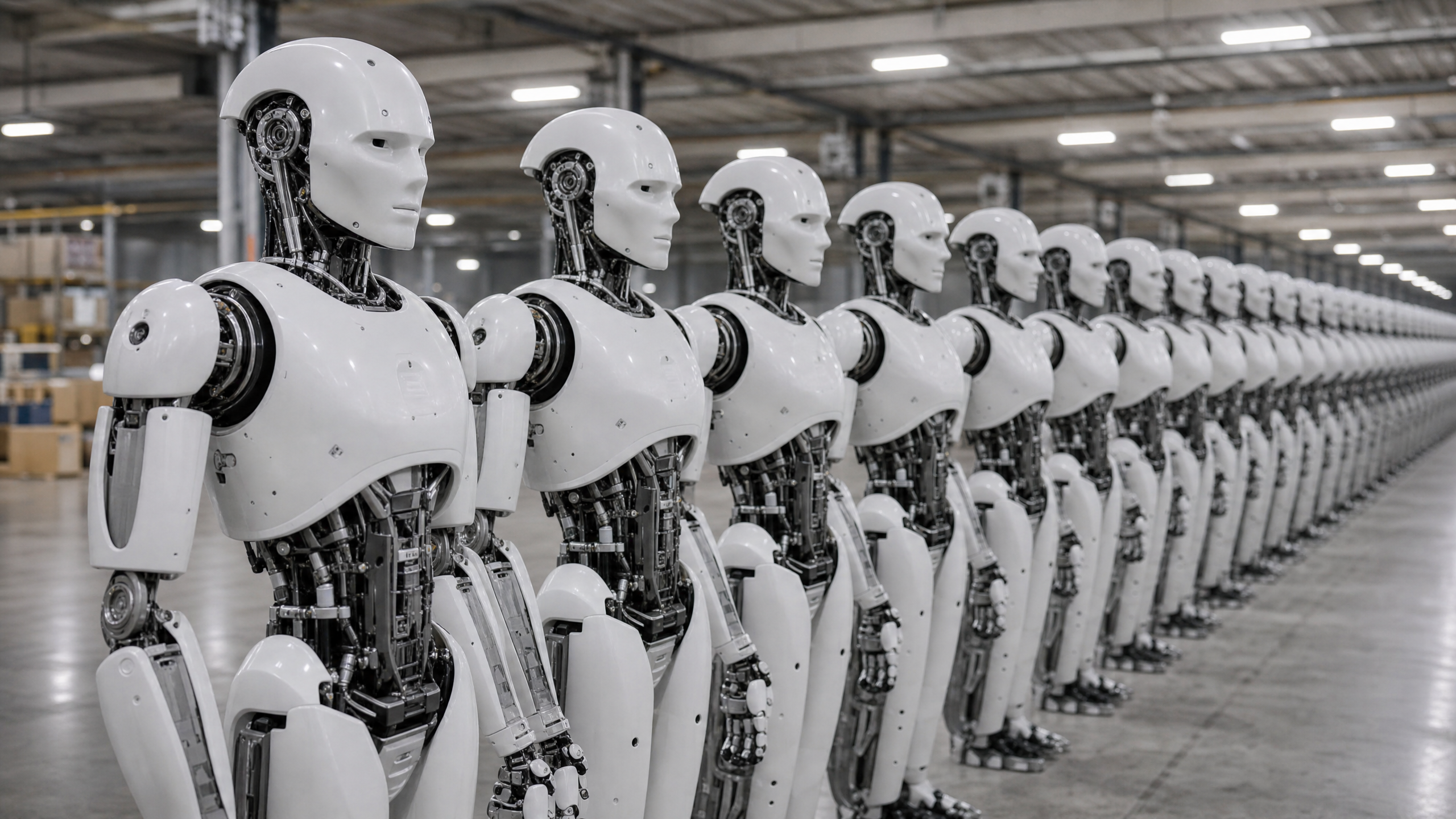
China's humanoid robot boom is attracting record capital — and the first signs of the same destructive price competition that crushed margins in EVs and solar panels.
China's humanoid robotics industry attracted over 200 billion RMB in disclosed investment in Q1 2026 alone, with more than 140 companies and 330 distinct products now competing for market share. A comprehensive June 15 investigation by Caixin Global confirmed what industry insiders had been warning for months: the sector is entering a period of severe price compression, particularly in lower-barrier segments such as semi-humanoid robots, educational platforms, and entertainment machines where hardware differentiation is increasingly difficult to sustain.
The Involution Playbook in Physical AI
The structural dynamics playing out in Chinese robotics are deeply familiar. A rush of new entrants, heavily backed by abundant venture and state capital, has created a crowded field where companies find it difficult to differentiate on software intelligence alone, because foundational AI models are still maturing and true generalised capability remains elusive. Competition is rapidly shifting to the hardware layer and, inevitably, to price. Companies are attempting to secure market share by undercutting competitors, sacrificing margins in the hope of surviving the inevitable consolidation.
This is the involution playbook. It played out in Chinese EVs, where BYD's scale advantages eventually forced dozens of smaller manufacturers into insolvency. It played out in solar panels, where Chinese overcapacity drove global prices to levels that made the industry structurally unviable for non-Chinese producers. The question now is how quickly humanoid robotics will follow the same trajectory.
The Strategic Split: Deploy Now vs. Train First
Industry roundtables have surfaced a fundamental strategic divide that will define which companies survive the shakeout. On one side, a faction of founders, including voices from AgiBot, argues that companies must deploy robots in real-world environments immediately, even with imperfect, narrow models. Their rationale: physical interaction data is the true bottleneck to progress, and this data can only be gathered through actual deployment. They draw an explicit parallel to autonomous driving, noting that companies which pursued incremental real-world deployment ultimately outperformed those that held out for generalised perfection in the lab.
On the other side, prominent voices warn against premature deployment. They argue that current foundational models possess the physical intelligence of "a one-to-two-year-old child" and should not be put to work in complex industrial settings before they have been properly trained, citing safety risks and the potential for reputational damage to the broader industry. The debate is not merely philosophical: the deploy-now camp risks producing unreliable robots that damage customer trust, while the train-first camp risks running out of capital before their models are ready.
The Capital Window Is Closing
The consensus among market participants is that 2026 represents a critical threshold for securing capital positioning. The current funding window, while massive, is beginning to close as investors demand commercial traction rather than impressive demonstrations. Companies that have not yet established a clear capital advantage, a robust supply chain, and a proprietary data pipeline will face severe structural disadvantages as the market consolidates around a small number of well-resourced leaders.
The "price war" will accelerate attrition among smaller players who cannot sustain the cash burn required to compete in an involuted market. The question is no longer who can build a humanoid robot but rather about who can survive the economics of selling one at scale.
The involution risk in humanoid robotics is real, but it is not evenly distributed. Companies with proprietary world models (Daxiao), specialised physical environments (Shihang), or state deployment mandates (MIIT/SASAC action) are structurally insulated from the worst of the price compression. The companies most at risk are those competing in the middle ground, capable enough to attract early customers, but not differentiated enough to resist margin erosion when a better-capitalised competitor decides to buy market share. The next 18 months will separate the platforms from the products.
Primary Sources:
1. Caixin Global — China's Humanoid Robot Boom Sparks Fears of Bruising Price Wars (June 15, 2026)
2. FutureX · Physical AI Daily, Issue 29 — China Robotics Intelligence Digest (June 16, 2026)
3. 21st Century Business Herald — Embodied Intelligence Capital Wave and Involution Risk (June 2026)
Disclaimer: All editorial content is independently written by RobotAIGeek based on publicly available Chinese and English-language sources. Quoted material is attributed to its original publisher. Market figures (e.g. investment totals, company counts) are drawn from cited sources and have not been independently verified by RobotAIGeek.