China's Server Chipmakers Are Coming for the Robot Controller
Hygon, China's listed x86 processor champion, is pushing its CPU1000 line into robotics. The robot controller is becoming a data-centre vendor's product, and buyers should read the toolchain before the benchmark.

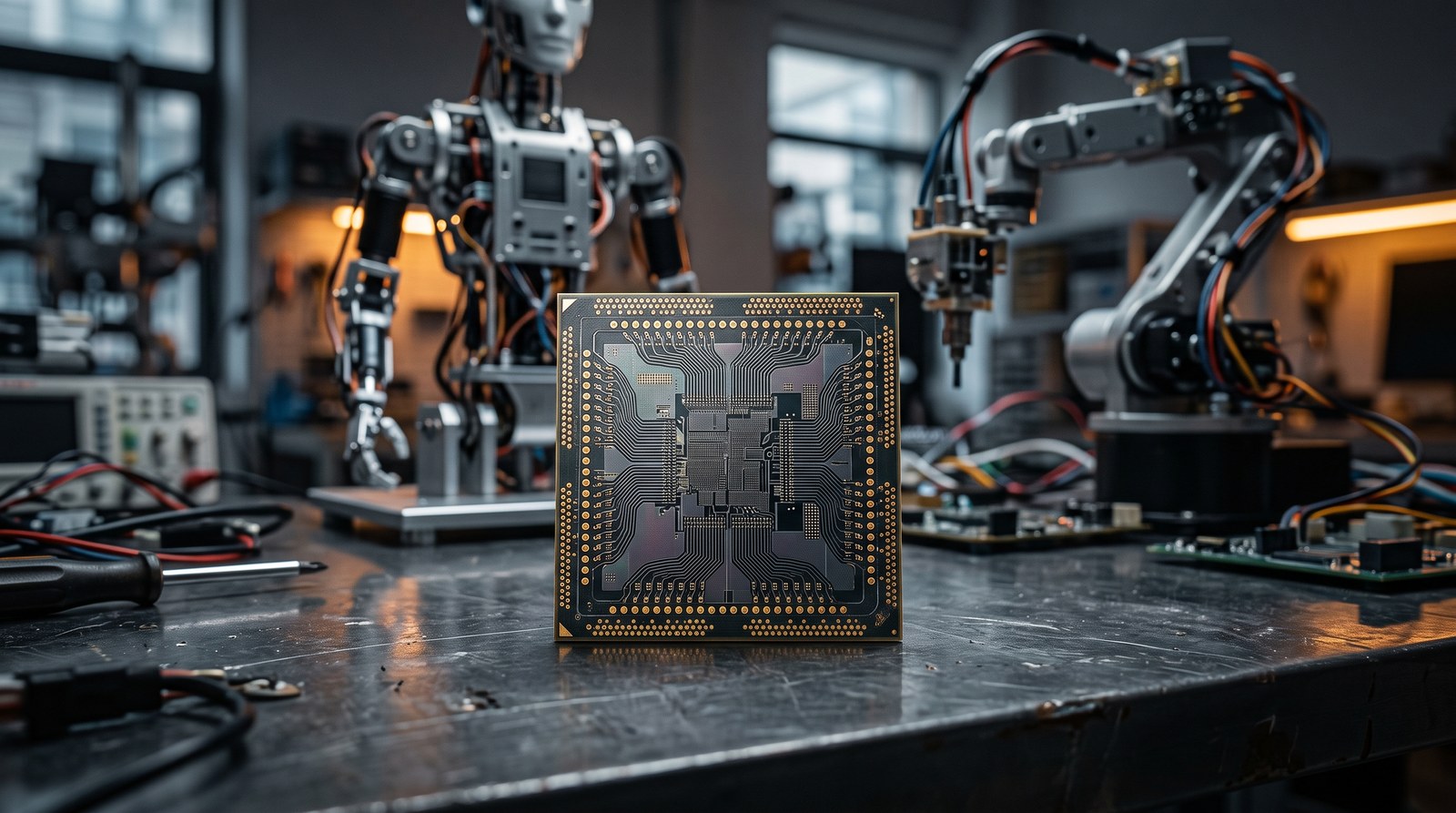
The most consequential robotics decision made in China this week will not involve a robot. It will involve a processor family designed for server racks.
Hygon Information Technology, the Shanghai-listed designer of x86-compatible central processing units (CPUs), scheduled a launch in Shenzhen on Tuesday 22 September 2026 for an iteration of its CPU1000 series. The company positions the part for low-power, embedded and edge computing across robotics, machine vision and intelligent manufacturing, under the slogan "Let computing power reach the physical world."
Read that announcement as a market signal rather than a product story. China's robot compute layer is being annexed by companies that already sell server silicon at national scale, and that changes the question every automation buyer will face over the next three years. It is no longer whether a Chinese robot can be bought at a good price. It is whose instruction set, whose compiler, and whose long-term support contract sits inside the machine on the factory floor.
The Profit Pool Is Moving From the Body to the Silicon
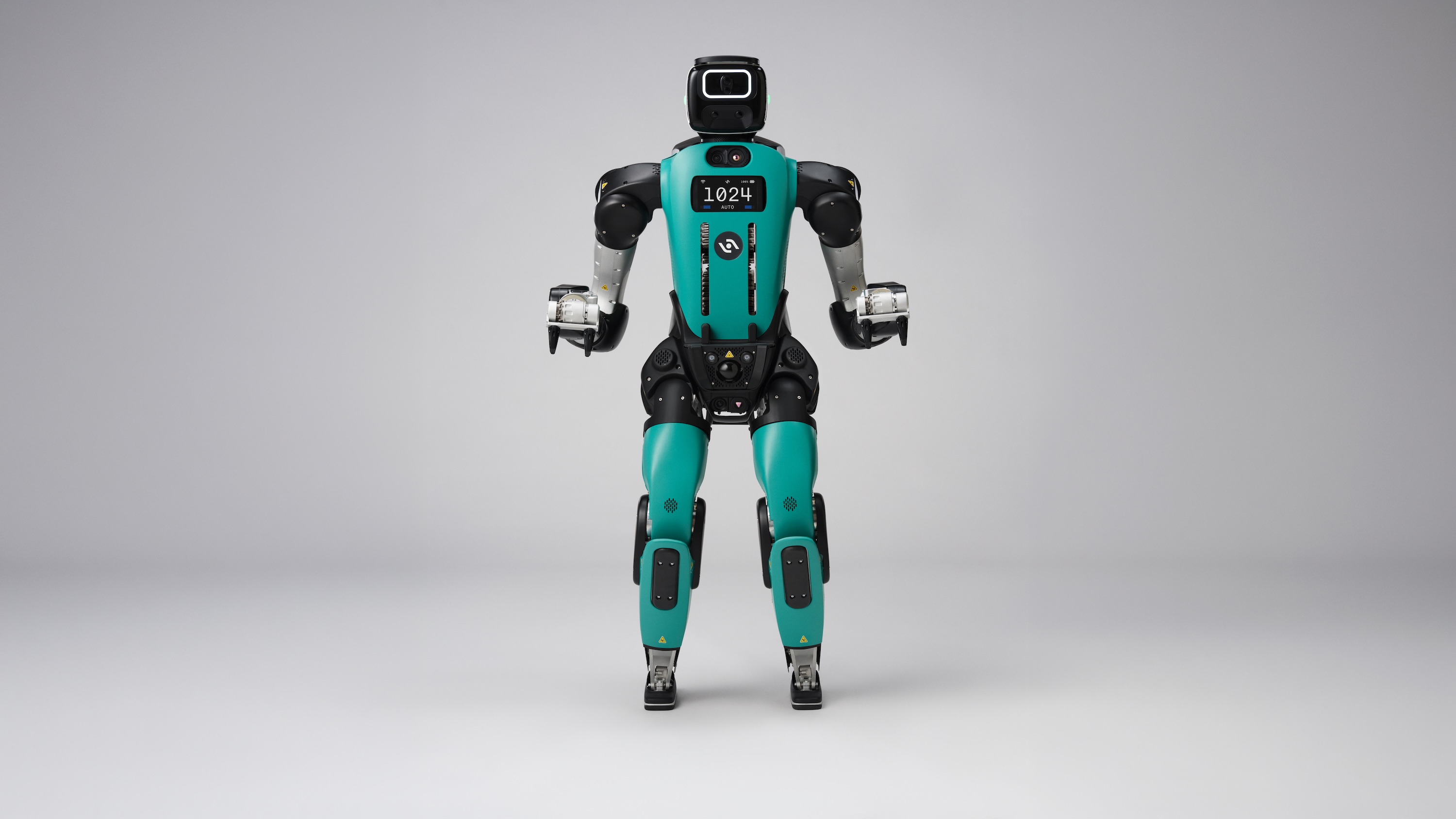
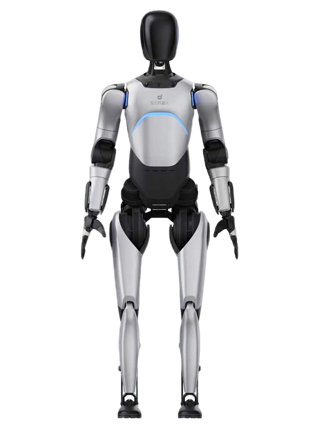
The economics driving this are already visible in the shipment data. Chinese manufacturers accounted for roughly 97 percent of mass-produced embodied artificial intelligence robot shipments in the first half of 2026, with narrow-definition humanoid shipments near 19,100 units and broader counts that include wheeled and service bodies exceeding 40,000. Two companies, AgiBot and Unitree, together hold close to 80 percent of that volume.
That scale has arrived alongside relentless price compression. Morgan Stanley models the average embodied artificial intelligence machine falling from about US$131,000 today to roughly US$23,000 by 2045, while the semiconductor share of the bill of materials rises from 4 to 6 percent today to around 24 percent over the same period. The same research puts the global market for semiconductors dedicated to embodied artificial intelligence robots as high as US$305 billion by 2045.
Strip the forecast horizon away and the mechanism is simple. Actuators, structures and harnesses are becoming commodity items produced by hundreds of Chinese suppliers, and their margins are collapsing accordingly. Compute is the one component that resists commoditisation, because it carries a software ecosystem that customers cannot swap without rewriting their applications. Whoever supplies the robot controller captures the durable margin in a machine whose sticker price keeps falling.
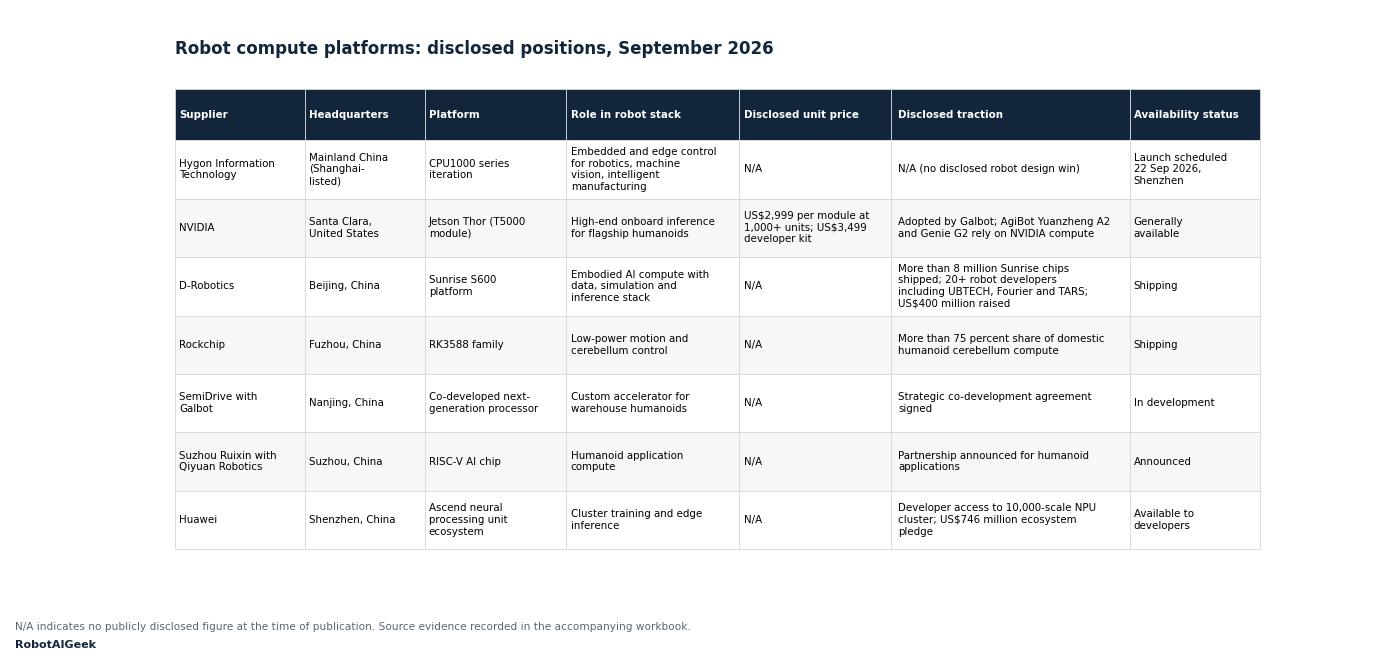
Chinese chip vendors have read that arithmetic. D-Robotics, the Beijing-based embodied intelligence chip developer behind the Sunrise computing platform, raised US$400 million this month to scale its Sunrise S600 stack, having shipped more than eight million Sunrise chips to over twenty robot developers including UBTECH, Fourier and TARS. Suzhou Ruixin paired a reduced instruction set computer five (RISC-V) artificial intelligence chip with humanoid maker Qiyuan Robotics on 20 September. SemiDrive, an automotive-grade processor designer, is co-developing a dedicated processor with warehouse humanoid developer Galbot. Huawei opened developer access to a ten-thousand-scale neural processing unit cluster on 19 September with a funding pledge of US$746 million behind its ecosystem.
Hygon entering the same contest from above, with data-centre revenue funding the move, is the point at which the robot controller stops being a startup market.
What a Server Vendor Brings, and What It Does Not
Hygon is not a robotics company and has no disclosed robot design wins. It is a semiconductor designer with three existing CPU families: the 7000 series for high-performance data centres, the 5000 series for mid-tier cloud and edge customers, and the cost-focused 3000 series. It also builds deep computing units, accelerator cards aimed at artificial intelligence workloads. Its first-half 2026 revenue rose 66.5 percent year on year to RMB 9.1 billion, approximately US$1.4 billion, on domestic demand for high-end processors that American export restrictions have made harder to source abroad.
Three of those attributes matter to a robot buyer. The first is balance-sheet endurance, which determines whether a controller family is still supported in 2032. The second is fabrication access under sanction pressure, since a robot fleet standardised on a part that cannot be manufactured is a stranded asset. The third is the software toolchain, where a vendor shipping into national data-centre programmes has compilers, drivers and support engineers that a two-year-old chip startup does not.
What Hygon brings less of is domain fit. Moving from a rack to a robot inverts the design constraints in a way that engineering prestige does not solve. A server chip optimises throughput inside a controlled thermal envelope with unlimited wall power. A robot controller runs on a battery, tolerates vibration and dust, must respond deterministically in real time, and shares a chassis with motor drivers that generate electrical noise. It is the difference between designing a power station turbine and designing a generator that fits under the seat of a delivery van, where the discipline transfers but nearly every constraint reverses.
The x86 architecture Hygon builds on is also an unusual choice for this market. Battery-powered robots have consolidated around ARM and, increasingly, RISC-V designs, chosen for performance per watt. Rockchip, the Fuzhou-based system-on-chip supplier whose RK3588 family dominates low-power robot control, holds more than 75 percent of the domestic humanoid cerebellum compute segment on exactly that basis. Hygon has disclosed no pricing, no power envelope, no robot customer and no software stack for the new part. A launch slogan is not a design win.
Two Supply Chains Now Run Through Every Chinese Robot
The current Chinese robot runs a split compute architecture, and the split is strategic rather than accidental. Flagship machines running multi-billion parameter multimodal models still rely on NVIDIA. Galbot was among the first to adopt the Jetson Thor platform, and AgiBot's Yuanzheng A2 and Genie G2 depend on NVIDIA compute. The Jetson Thor developer kit lists at US$3,499, with the T5000 production module at US$2,999 per unit in orders of a thousand or more.
Cost-optimised machines take the domestic path, built on Rockchip silicon and increasingly on custom application-specific integrated circuits. Morgan Stanley's analysis indicates domestic inference solutions deliver total cost of ownership 30 to 60 percent below overseas equivalents in large-scale deployment, even where single-chip performance trails by a generation.
The dual-track arrangement exists because neither track is safe on its own. The imported track is exposed to an export-control decision that Washington has openly debated, since an embedded module with data-centre-class throughput sits uncomfortably close to the accelerators already restricted. The domestic track is exposed to a performance ceiling that constrains what the most capable models can run onboard. Chinese manufacturers are hedging, and every vendor that improves the domestic track shifts the hedge.
That is the strategic content of Hygon's move. It is not competing with NVIDIA for the flagship humanoid brain. It is competing for the far larger volume of machine vision systems, automated guided vehicles, inspection robots and factory controllers where power budgets are generous, x86 compatibility with existing industrial software is an advantage rather than a handicap, and the buyer's real requirement is a supplier that will still exist and still ship in eight years.
The Lock-In Buyers Are Not Pricing
Procurement teams evaluating Chinese automation are mostly comparing unit prices, payload and cycle time. The compute layer rarely appears on the scorecard, which is where the expensive surprise lives.
Standardising a fleet on a robot means inheriting its controller, and the controller carries a toolchain. Migrating a deployed application from one inference runtime to another consumes engineering months, revalidation cycles, and in regulated environments a fresh safety case. That switching cost is the entire reason chip vendors are chasing this market. It is also why the cheapest machine in a tender can be the most expensive decision in it.
Buyers outside China face a second layer. A fleet standardised on domestic Chinese silicon may be unsupportable in jurisdictions that restrict the vendor, and the reverse is equally true inside China, where machines built on imported compute carry the risk of a licence change. Neither risk shows up in a quotation. Both show up in year four of an eight-year asset life.
In robotics, the chip that wins is rarely the fastest one. It is the one whose toolchain a systems integrator can still keep alive a decade after the sale.
There is a counterweight that deserves equal weight. Return on investment for humanoid deployment in China currently runs to a 6.7 year payback against roughly 2.7 years in the United States, a gap driven by lower Chinese manufacturing wages. Compute lock-in matters most where the deployment lasts long enough for the lock to bind, and a large share of current Chinese robot volume goes to research, education and data collection buyers whose machines will be replaced before any migration cost arrives. Unitree's entry-level body at RMB 29,900, approximately US$4,200, accounts for a substantial share of installed units and is effectively disposable. At the other end, UBTECH's U1 at RMB 880,000 to RMB 990,000, approximately US$124,000 to US$139,000, is an asset that will be maintained, migrated and argued about for years.
How to Buy Into a Compute Layer That Has Not Settled
The practical response is not to wait for a winner. The compute layer will not settle before 2028, and holding automation investment until it does concedes the productivity gain to competitors who moved.
Four disciplines protect a buyer through the transition. Specify the controller explicitly in the tender, including chip family, inference runtime and the vendor's committed support window, rather than accepting the integrator's default. Require the supplier to state in writing which compute variants of the same machine are available, because most Chinese vendors now build both domestic and imported configurations and will supply either. Keep the application layer portable by containerising perception and task logic where latency permits, so a controller change costs weeks rather than quarters. Treat compute as a serviceable component with its own refresh schedule, in the way a fleet manager treats batteries, rather than as a permanent fixture of the chassis.
The comparison table accompanying this article sets out the disclosed position of each major robot compute platform, with unavailable figures marked as not available rather than estimated. Very little pricing is public in this market, and that opacity is itself a procurement finding.
Hygon's launch will be covered as a chip story. It is better understood as the moment China's robot supply chain started to look like its automotive supply chain: bodies from everyone, margins in the electronics, and a buyer's leverage determined entirely by what was written into the specification before the first unit shipped. The companies that will regret this decade are not the ones that bought the wrong robot. They are the ones that never asked what was inside it.
This analysis synthesises company statements, exchange-listed financial disclosures, supplier announcements, published market research, and public pricing available at the time of publication.
Disclaimer: This article is for informational purposes only and does not constitute investment, procurement, legal, or medical advice. Figures, specifications, pricing, and forecasts reflect information verified at the time of publication and may change.