Robotics' Smallest Funding Rounds Reveal Where the Real Moat Hides
Haystack Robotics' US$3.95 million Series A and Jaipur Robotics' EUR4.3 million seed round both closed this week as two of physical AI's smallest financings. Read side by side, they show where specialization capital in robotics actually sits: not in the hardware, but in whoever ends up owning the data the robot generates after it ships.

Two robotics financings closed this week that most funding trackers will file under "too small to matter." Haystack Robotics, a Portland disinfection-robot maker, raised a US$3.95 million Series A. Jaipur Robotics, a Swiss industrial-vision startup, raised a €4.3 million (about US$4.6 million) seed. Compared with Figure's multibillion-dollar compute commitments or the humanoid megarounds that dominate this outlet's own coverage, both look like rounding errors.
Read side by side, they are the clearest test available right now of where specialization capital in physical AI actually sits, and it is rarely inside the robot.
I run a platform that tracks robot and company data by hand for a living, which means I spend more time than most reading seed-stage funding language literally rather than skimming it for the headline number. What a small round's lead investor is and what the company chooses to disclose about its own operating data tell you more about the durability of the bet than the check size ever will.
The company that sold a dataset, not a robot
Jaipur Robotics builds computer-vision systems for waste-to-energy plants: cameras and models that spot hazardous material on a conveyor before it reaches a furnace, and guidance systems that steer cranes through waste pits more precisely than a human operator working by sightline. The company's own announcement of the round states specific, falsifiable operating numbers: a system trained on more than 50 million labeled images, analyzing over 5 million tonnes of waste a year, detecting hazardous material at a stated 99 percent accuracy, and producing a claimed 80 percent reduction in unplanned shutdowns per plant per year.
Whether every one of those figures survives independent audit is a fair question for any founder's own numbers. What matters for the funding thesis is that Jaipur chose to lead with them instead of a market-size slide. The company frames the roughly 3,100 waste-to-energy plants operating worldwide as a large but finite, mostly manually monitored install base: the kind of long-cycle, unglamorous infrastructure market that rewards whoever accumulates the most labeled failure cases first, because a competitor entering two years later starts with zero.
That is a data-moat argument, and it only works if the data keeps compounding after the check clears. Seed-stage co-lead HTGF is a German public-private early-stage fund; EquityPitcher focuses specifically on DACH-region AI and deep-tech. Neither profile suggests a quick flip. Both look built for a company whose value curve is supposed to still be climbing in five years, not eighteen months.
The company that sold access to someone else's ledger
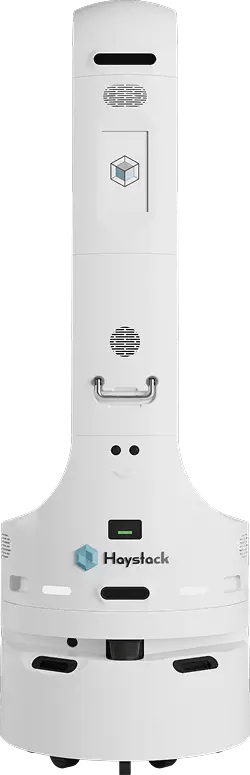
Haystack Robotics makes an autonomous UV-C disinfection robot called Violet, aimed at hospitals, senior living facilities, and hotels. Its Series A was led by an investment entity associated with Agadia Systems, a healthcare utilization-management company whose core business is helping insurers and pharmacy benefit managers process prior-authorization and claims data.
A payer-adjacent data company, not a robotics fund, wrote the largest check.
That detail matters more than the US$3.95 million headline number. It suggests the bet is not primarily "this robot cleans rooms well": UV-C disinfection is close to two decades old as a hospital technology, and the physics has not changed. The more interesting bet, if the investor's own business model is any guide, is that an autonomous disinfection fleet generates a stream of room-level, timestamped disinfection records that could eventually be matched against infection-related insurance claims. If that link ever gets validated at scale, the compounding asset is not the robot fleet. It is the claims-linked outcomes data sitting downstream of it, owned by whoever controls that ledger, which, on the current cap table, is not Haystack alone.
Haystack is also not entering an open field. Ecolab folded UVD Robots into its global infection-prevention portfolio for healthcare customers back in January 2022, a signal that a chemicals-and-services incumbent, not a standalone robotics company, now controls one major distribution channel into hospitals. Xenex Disinfection Services and Tru-D SmartUVC have operated as established, well-funded pure-play competitors for years. Haystack's earlier seed, a reported US$2.7 million round in 2024, means this Series A brings its disclosed lifetime funding to roughly US$6.65 million, a fraction of what the incumbents have already raised and deployed. Hardware alone was never going to be Haystack's edge in this market. That may be exactly why its lead investor is not a hardware investor.
Same capital logic, opposite ownership structure
Put the two rounds next to each other and a single question emerges: when the robot itself is not the moat, who ends up owning the thing that actually compounds?
- Jaipur keeps the compounding asset in-house: the labeled dataset is the company's own IP, built from its own deployed sensors, on its own balance sheet.
- Haystack's compounding asset, if the thesis plays out, may end up structurally owned by an investor whose core business already sits downstream of the robot's output.
Neither structure is wrong. But they carry different tail risks. Jaipur's model fails if the data does not generalize past its current customer base, or if a larger industrial-automation player builds a comparable dataset faster by paying for access to more plants. Haystack's model fails in a subtler way: if the claims-data thesis never gets validated, or the linkage proves too legally fraught for a payer-adjacent investor to fully exploit, the robotics company is left holding a commoditizing UV-C hardware business inside a market three well-capitalized incumbents already occupy, without ever having captured the data asset its own lead investor was actually buying.
There is also a scale caveat worth stating plainly: two funding rounds in one week is a pattern of exactly two. I would not build an investment thesis on it alone. What makes it worth writing about is that both companies made their ownership structure for the compounding asset legible in public materials, which most funding announcements do not bother to do.
What this means from a market that mostly imports both models
Writing from the Philippines, where most of the robotics I see procured is imported rather than built locally, this distinction is not academic. A hospital group or a waste-management operator here evaluating either category of vendor should ask a question neither funding announcement answers directly: five years from now, does the value your money buys still belong to the company selling you the robot, or has it migrated to a data holder you never signed a contract with? For hardware that is genuinely getting commoditized, and UV-C disinfection is a strong candidate, that question determines whether today's vendor is still improving the product in 2031, or has become a distribution arm for someone else's data business.
The most useful diligence question for any small robotics round is no longer "how big is the market." It is "who owns the thing that gets better after the sale." Robotics coverage still defaults to sizing rounds against total addressable market, a habit inherited from software investing, where the product and the compounding asset are usually the same artifact. In physical AI, they are splitting apart, and this week's two smallest rounds happened to make that split unusually visible.
The next wave of small robotics financings will keep answering this question, mostly by accident, in whatever detail their own press releases choose to disclose. Read those disclosures for what they reveal about ownership, not just size, and the picture of where physical AI capital is actually headed gets a good deal sharper than any funding leaderboard shows.
Disclaimer: This column reflects the author's own analysis and is provided for general information purposes only. It does not constitute investment, financial, legal, or procurement advice. Readers should verify details with primary sources before making business decisions. Figures for Jaipur Robotics are as disclosed in the company's own funding announcement and have not been independently audited. Hero image: Haystack Robotics' Violet Gen4 disinfection robot, official Haystack Robotics product photography.