Japan Capped Its Restaurant Worker Visas. Then It Shipped the Robot.
Japan's Specified Skilled Worker quota for restaurant jobs is nearly capped at 50,000. Days after the government moved to pause new approvals, SoftBank Robotics and Bear Robotics launched a narrow-aisle delivery robot built for the same venues, and the timing says more about immigration policy than a demographic labor shortage.

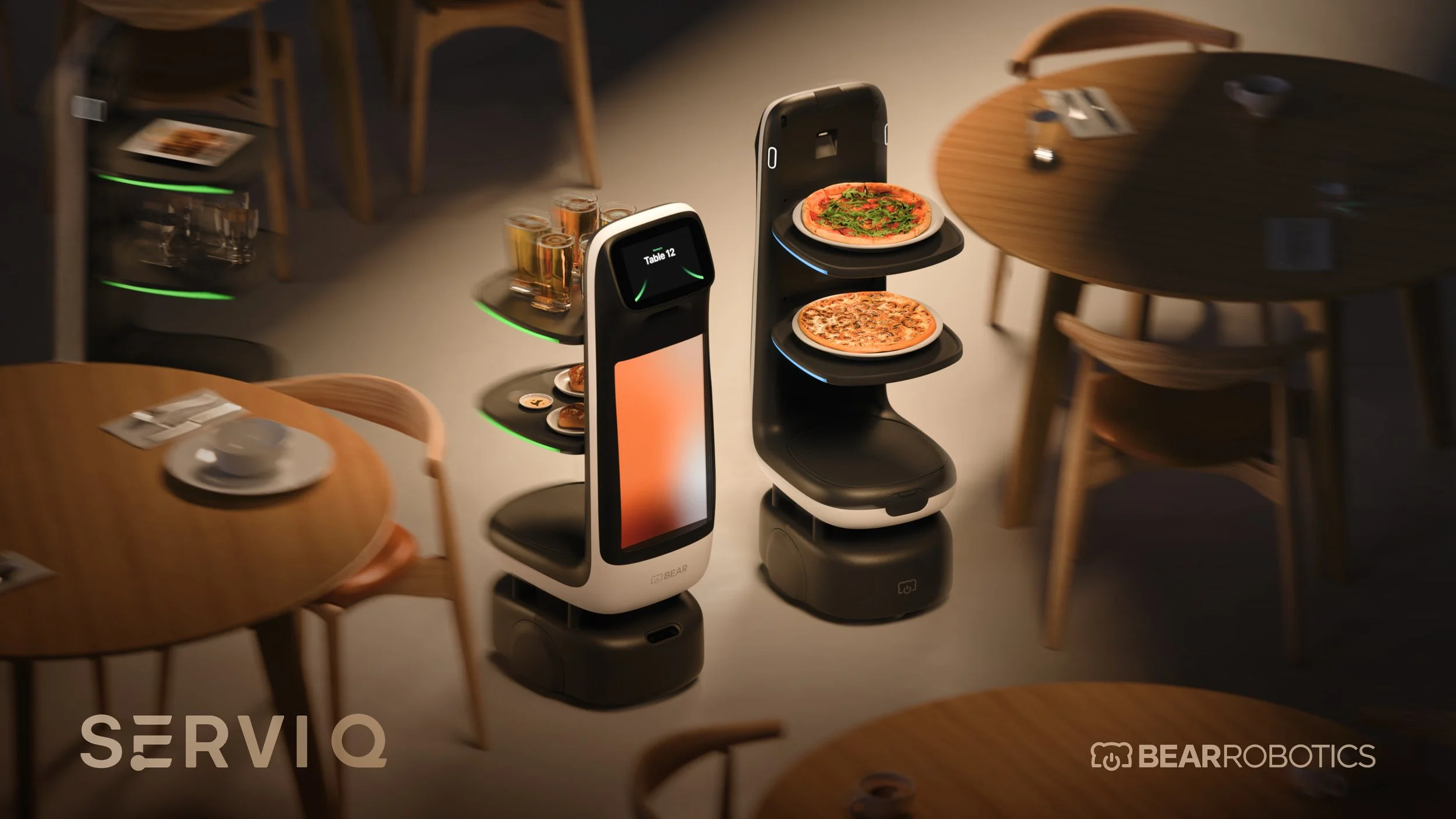
On September 28, SoftBank Robotics and Bear Robotics put a new delivery robot called Servi Q on sale across Japan, engineered to squeeze through a 45-centimeter gap that no service robot in its category had managed before. Weeks earlier, and with almost no coverage outside trade circles, Japan's government quietly moved to shut the door on new restaurant workers entering the country under its main foreign-labor visa, because the sector had all but filled its quota.
Those two facts are usually told as separate stories: one about clever engineering, one about immigration bureaucracy. Read together, they say something sharper about why Japan's restaurants are automating right now.
The standard framing, in every press release and most of the coverage that follows one, is that Japan's hospitality sector is short of people because the country is short of people, full stop: a shrinking working-age population, a service industry that cannot hire its way out. That framing is true as far as it goes. It is also incomplete in a way that matters for how anyone reads the next twelve months of Japanese service-robot deployments.
Japan did not just run out of restaurant workers. It set a number, and the number was small.
Start with what Servi Q actually solves. It is 35 centimeters wide, narrow enough to fit through passages most delivery robots cannot, and it can drive in reverse out of a dead end without a staff member walking over to redirect it. Both features target the same problem: a large share of Japan's restaurant and care-facility floor space was built before automation was a design consideration, with aisles too tight and corridors too twisty for the wider robots already selling well in newer, purpose-built venues. SoftBank Robotics has run a wider Servi line in Japan since 2021 in partnership with Bear Robotics, the Mountain View robotics company that built the underlying platform; Servi Q is the compact end of that lineup, not a new category. It also arrives into a market where Chinese vendors, led by Shenzhen's Pudu Robotics and Keenon Robotics, already sell narrow-body delivery robots at lower prices, so the pitch has to win on fit and support, not on being first.
None of that engineering context explains why a Japanese restaurant would choose a robot over simply hiring someone. For that, look at the visa math.
The quota nobody put in the press release
Japan's Specified Skilled Worker program is the main channel through which foreign nationals fill labor gaps in sectors the government has formally designated as short-staffed, and it sets a numerical ceiling for each sector. For food service, that ceiling is 50,000 workers across a five-year window running through March 2029. By the end of last year, 43,869 Type 1 workers had already been accepted into the sector. By the end of February, the figure stood at roughly 46,000, an eightfold increase in three years. Facing a cap it was about to hit, the government moved in March to suspend new food-service approvals in principle starting in mid-April.
That is a government choosing, deliberately and on a schedule, how many human workers are allowed to fill the exact jobs Servi Q is now being marketed to cover. It is not a shortage that simply happened to the industry; it is a shortage with a number attached, set well below what the industry says it needs.
The comparison sharpens the point. Nursing care, a sector with its own well-documented staffing crisis, carries a quota of 126,900 under the same program. Food and beverage manufacturing sits at 133,500. Food service, at 50,000, was capped at roughly a third of either. Whatever criteria set those numbers, food service was never treated as the most urgent gap to fill with people. It may simply be the easiest one to fill with machines instead, which changes the causal story: automation here is not purely chasing scarcity, it is partly absorbing a ceiling the policy itself drew.
A second door closing at the same time
The visa quota is not the only lever moving. Japan's Immigration Services Agency is revising its permanent residency guidelines this month, adding an income test pegged to the average Japanese household, a pension-contribution record equivalent to thirty years in the national employee pension system, and a Japanese-language proficiency requirement. The tightened standard applies to applications filed from this past April, with full implementation targeted for April 2027. None of that touches Specified Skilled Worker visas directly, which are temporary by design, but it signals a consistent policy direction: fewer new entrants into capped sectors, and a higher bar for anyone already here who wants to stay for good.
Put the two together and the picture is not robots because there are no people. It is closer to a smaller, harder-to-renew human pipeline into exactly the venues where a narrow-aisle robot now has the clearest opening to sell.
What this means from an ASEAN seat
I run a robotics data platform from the Philippines, which makes this a live question rather than an abstract one. Filipino workers are the third-largest foreign workforce in Japan, at 260,869 as of last October and still growing, with nearly 24,000 of them in medical and welfare roles that sit adjacent to the nursing-care quota rather than the food-service one. For a labor-sending economy, a robot headline out of Tokyo is easy to misread as a demand signal: Japan is automating, so fewer visas will be needed, so plan accordingly. The visa numbers say something more specific. Japan's appetite for foreign labor has not shrunk uniformly. It has been reshaped sector by sector, with food service capped tightly while nursing care and food manufacturing keep far larger allocations open. A robot filling the tightest-capped gap is not the same signal as a robot displacing demand across the board, and treating it as one risks reading a policy artifact as a market trend.
That distinction should matter to anyone advising migrant workers on where the next five years of opportunity sit, and it should matter to robotics vendors deciding which Japanese sector to enter next. The sector with the most restrictive visa quota is, almost by definition, the one where a machine faces the least human competition for the job.
Where this reading could be wrong
The honest caveat: none of this proves SoftBank Robotics or Bear Robotics timed their launch around a visa cap, and there is no evidence either company thought about the quota at all. Japan's population decline is real, its tourism-driven demand for dining and hospitality capacity has genuinely returned to record levels, and the buildings Servi Q targets, older izakaya, traditional ryokan corridors, cramped care facilities, were never going to be staffed by a fresh wave of visa holders regardless of the cap, simply because renovating around a wider robot or a standard floor plan was never on the table for them either. The scale mismatch also cuts against a tidy story: 50,000 capped visa slots against a national restaurant and hospitality footprint of hundreds of thousands of venues is not a one-for-one substitution, and Servi Q's real-world reliability, including whether its reverse-driving actually works during a packed Friday service rather than a quiet demo, is still unproven. Pricing for the robot remains undisclosed, which means the economics anyone is betting on right now are incomplete on both sides of the ledger.
What to watch next
The useful signal is not the robot launch itself. It is whether Japan raises the food-service quota once Servi Q and its rivals have a year of real deployment data behind them. If the ceiling stays where it is, or falls further, that is a government treating automation as a substitute for the human pipeline it chose to narrow, not merely a complement to a shortage it cannot help. Everyone covering Japan's service-robot wave as a demographic inevitability should start asking the same question I ask before adding a new deployment to this platform's data: is the gap a fact of headcount, or a fact of policy? In Japanese food service this year, the honest answer is both, and the second half of that answer is the part nobody is putting in the press release.
This analysis reflects the author's own reading of public disclosures, government program data and company statements as of the publication date, and should not be read as investment, immigration, or professional advice; it is provided for general information purposes only.
Hero image: Bear Robotics.