From Factory Floor to Warehouse: How Humanoid Robots Are Deployed
Official-source case evidence from automotive manufacturing, consumer electronics and contract logistics shows where humanoid deployment is becoming operationally testable: bounded tasks, stable interfaces, and measurable pilot gates.
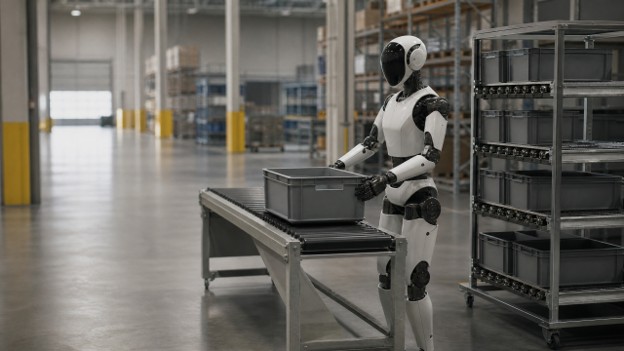
A humanoid deployment is not proven by a robot entering a building. It is proven when a buyer can define one task, connect it to the surrounding workflow, train the operating team, and measure whether the task remains stable through a real shift. The early official cases are therefore more useful as operating templates than as proof that a whole industry has scaled. They point to a narrow but practical starting point: repetitive handling and inspection work in spaces that already need people.
The official record does not provide a comparable global count of commercial humanoid deployments by industry, a cross-vendor productivity benchmark, or a reliable total-cost-of-ownership series. This matters because a promotional demonstration cannot answer a procurement question. The relevant evidence is task-level: what was moved, inspected, sorted, or positioned; for how long; in which operating environment; and at what stage of deployment.
Primary Industries
The clearest documented industrial use cases are in automotive manufacturing, consumer-electronics manufacturing, and warehouse or contract logistics. These are not necessarily the largest markets for humanoids. They are the sectors for which qualifying official sources describe a task, a site, and a deployment stage. That distinction should guide a buyer’s reading of the current evidence.
Automotive manufacturing is a natural test bed because many workflows combine physically demanding handling with precisely defined locations. BMW Group reported that a Figure 02 humanoid supported production of more than 30,000 BMW X3 vehicles at Plant Spartanburg over ten months in 2025. The task was to remove and position sheet-metal parts for welding. The same official disclosure describes a later Figure 03 project for logistics sequencing, where the robot is to sort unsorted delivered components into a trolley before they move to the assembly area. For an automotive buyer, the insight is not that a humanoid replaces the body shop. It is that a discrete handling or sequencing task can be trialled inside an existing automation ecosystem.
Consumer-electronics manufacturing offers another starting point because product inspection and material presentation can change with model mix. The Pudong New Area Government reported that AgiBot humanoid robots completed an eight-hour shift on a Jiangxi electronics line, performing pick-and-place work, identifying defects, and linking to the factory system. The report states that the deployment processed about 310 units an hour. This is a useful deployment example because the task is specific and its reported output is bounded. It is not a general productivity benchmark for every electronics line.
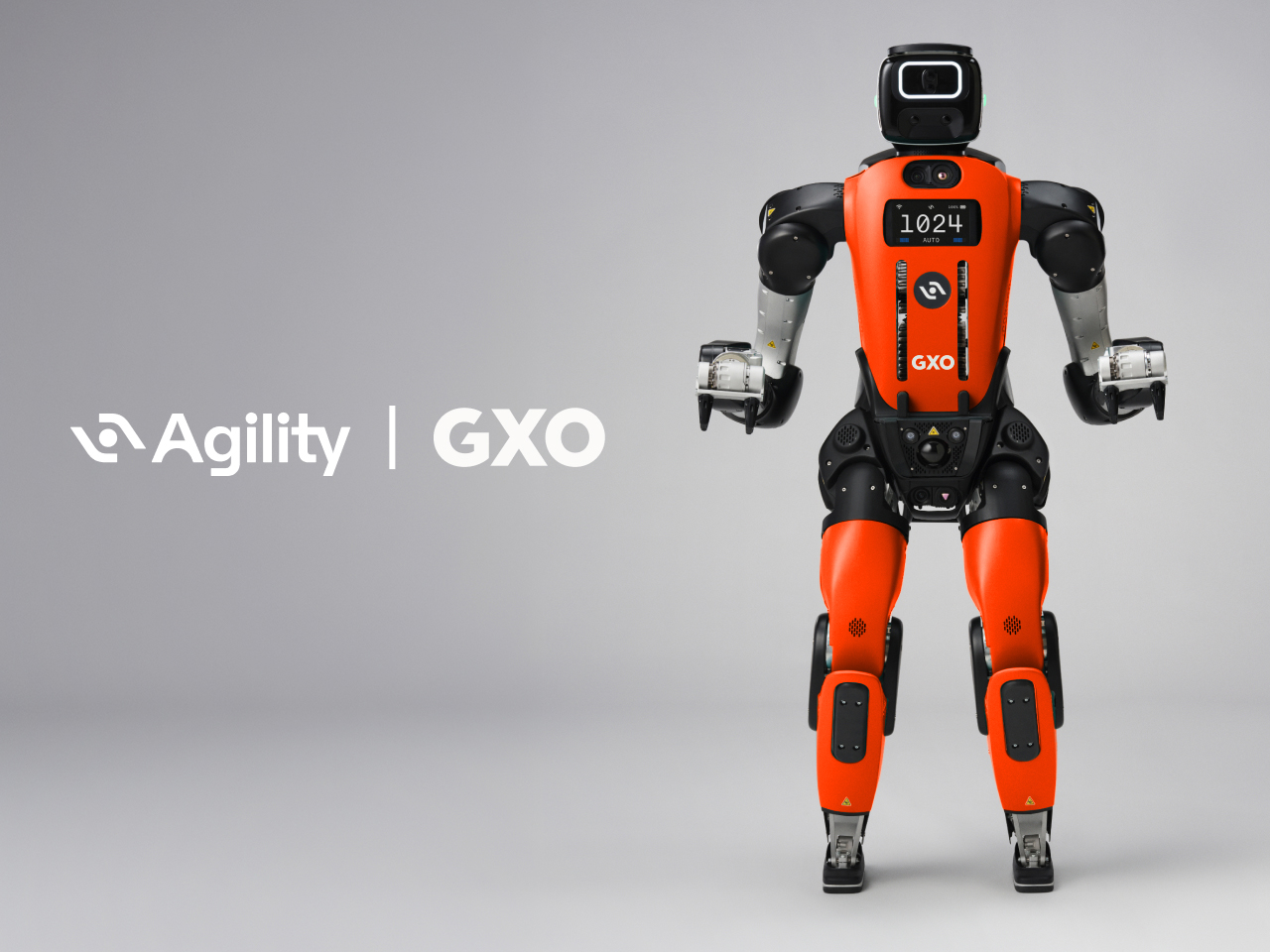
Warehouse and contract-logistics operations are a third documented setting. GXO Logistics disclosed a live warehouse deployment of Digit robots and a fleet-management platform at a SPANX facility. The stated task was moving totes from collaborative robots to conveyors. Amazon has separately described testing Digit for tote recycling in its operations. Both cases reinforce the same operational logic: a humanoid’s first warehouse job is more likely to be a repeatable handoff between existing systems than an open-ended instruction to manage an entire facility.
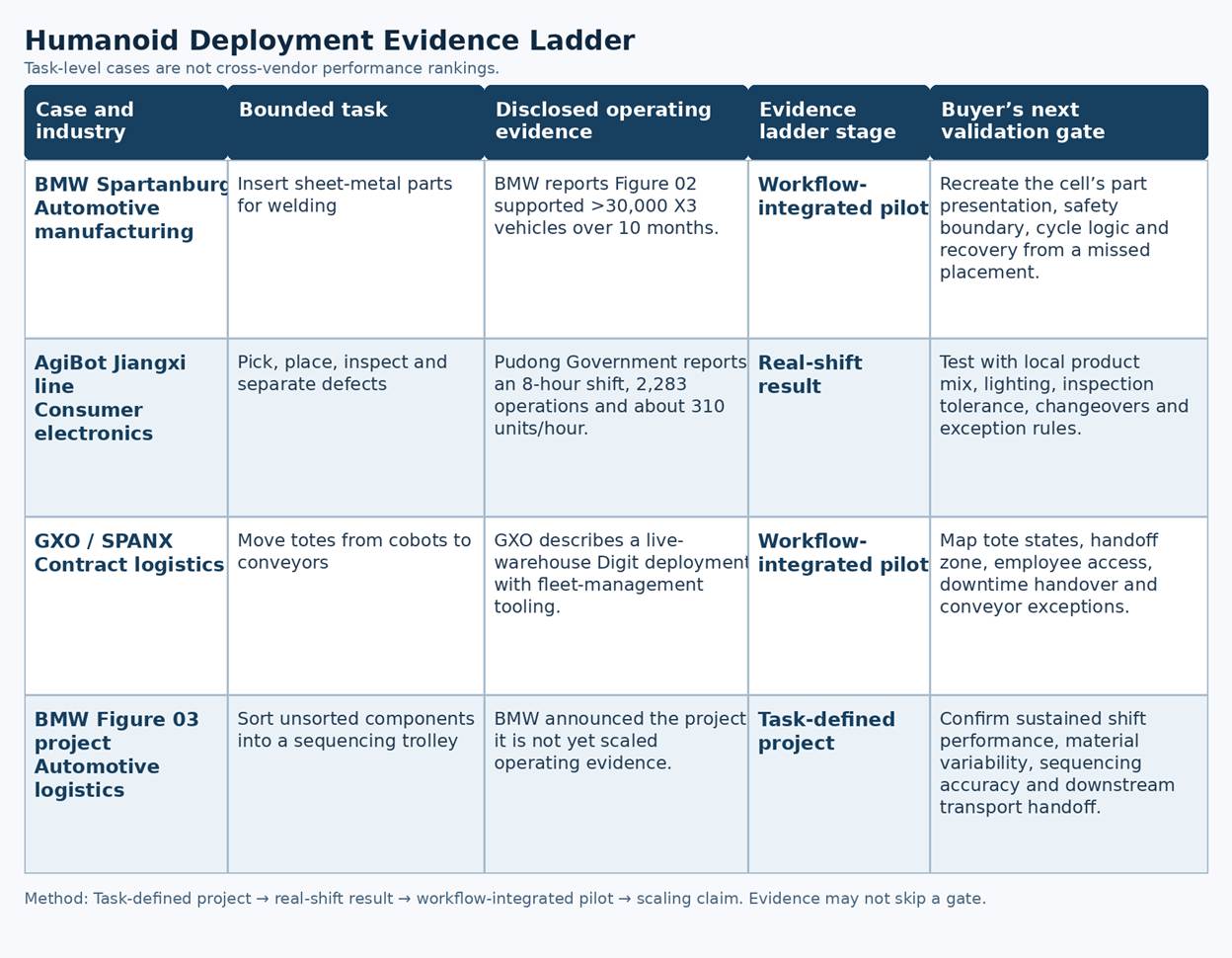
The table applies an original deployment-evidence ladder. It separates a task demonstration, a real-shift result, a workflow-integrated pilot, and a scaling claim. A case advances only when the disclosed evidence supports the next gate. The method does not rank robots, predict returns, or make unlike facilities comparable. It is a way for a buyer to ask for the missing evidence before expanding a pilot.
Specific Application Examples
The most useful application examples are defined by the interfaces around the robot. In BMW’s body shop, Figure 02 handled a sheet-metal insertion sequence for welding. The part, location, and next process were known. The buyer can therefore evaluate accuracy, cycle stability, workstation access, handoff to the welding process, and the recovery procedure for a missed placement. The deployment evidence is meaningful precisely because it is narrower than a claim of general factory autonomy.
On the China electronics line, the operating sequence combined conveyor pickup, placement into testing boxes, and defect segregation for staff retrieval. The government report describes completed shifts and stated performance data, including 2,283 pick-and-place operations. A procurement team should treat that as a site-specific case study, then recreate the test with its own lighting, parts, packaging, changeover frequency, inspection criterion, and line-speed requirement. A reported success rate from one line is not portable until those operating conditions are made comparable.
In contract logistics, the tote transfer described by GXO is a useful example of a bridge task. The robot is not being asked to redesign storage, run inventory control, or replace the surrounding autonomous mobile robots (AMRs). It is filling a physical gap between two parts of the workflow. That framing gives the integration team a manageable test: map the handoff zone, define tote states, handle exceptions, set employee access rules, and measure whether the robot reduces a bottleneck without creating a new one.
BMW’s Figure 03 project adds a more advanced application example: sequencing. Incoming components arrive in larger containers, are picked and sorted into a trolley, and are sent to a collection point for onward transport to the assembly location. The announced use case is still a project, not evidence of scaled operations. Its value is as a design pattern for buyers who need a robot to impose order on a bounded input stream before a conventional transport system performs the next step.
China Deployment Example
China provides a concrete electronics-manufacturing example, not a verified national deployment count. In April 2026, the Pudong New Area Government reported an AgiBot deployment at a Jiangxi production line that completed an eight-hour continuous shift. The reported work combined pick-and-place operations, defect identification, and factory-system connectivity. The source records 2,283 operations and about 310 units an hour.
For a China-based buyer, the relevant question is whether the factory can reproduce the conditions that made the reported result possible. The due-diligence brief should specify the product mix, conveyor geometry, allowable defect types, expected human intervention, maintenance window, and line-change procedure. It should also distinguish an observed demonstration, a defined pilot, and a recurring production workflow. The government report documents a single named facility case; it does not establish that the same result will apply across consumer electronics or across different humanoid platforms.
The case also shows why hardware form is only part of the decision. The robot’s value depends on integration with the production line, quality criteria, material presentation, and exception handling. A buyer that cannot describe those interfaces should not start with a multi-purpose deployment. It should start with one measurable operation and a clear rule for stopping the pilot.
Global Deployment Example
Outside China, BMW’s Spartanburg deployment is a stronger global reference because the company discloses both the task and the operating history. BMW states that Figure 02 supported production of more than 30,000 X3 vehicles over ten months by inserting sheet-metal parts for welding. Its February 2026 disclosure adds that the robot moved more than 90,000 components in about 1,250 operating hours. Those figures relate to BMW’s own pilot and should not be used to rank other suppliers or plants.
The useful lesson is BMW’s staged deployment method. The company describes a sequence from theoretical assessment to laboratory evaluation using real use cases, then a test deployment under production conditions, and only then an actual pilot. It also says that production information technology, occupational safety, process management, and shop-floor logistics were involved early. This is a better procurement model than starting with a broad request for a general-purpose worker. It makes every function responsible for the evidence needed to move to the next phase.
Emerging Use Cases
The next use cases are likely to remain close to existing industrial workflows. BMW’s Leipzig work is exploring applications in high-voltage battery assembly and component manufacturing, while its Spartanburg Figure 03 project is aimed at logistics sequencing. These examples support a cautious conclusion: the emerging opportunity is not unlimited versatility but the ability to move a human-form machine across adjacent tasks where fixed automation would require extensive redesign.
Regulation will also shape which use cases move first. The European Union Machinery Regulation applies from 20 January 2027 and explicitly addresses autonomous mobile machinery, connected equipment, and artificial intelligence using learning techniques for safety functions. In the United States, the Federal Communications Commission updated its Covered List on 28 July 2026 to cover certain foreign-produced advanced robotic devices, including qualifying mobile humanoids. New covered models generally cannot receive authorization for import, marketing, or sale without the applicable approval process. These rules do not determine whether a robot can perform a task, but they do determine whether a buyer can lawfully procure, connect, and maintain a proposed system.
The practical procurement thesis is therefore straightforward. Start with a task that has a known handoff, a measurable result, and a contained failure mode. A robot that can demonstrate stable sheet-metal placement, tote transfer, electronics inspection, or parts sequencing under production conditions earns the right to a larger pilot. A robot that cannot should not be asked to solve the warehouse or factory as a whole. The next chapter in humanoid deployment will be written through repeatable work cells and workflow interfaces, not through the breadth of a demonstration.
Disclaimer
This article is published by RobotAIGeek for informational and educational purposes only. It does not constitute procurement advice, engineering advice, safety advice, legal advice, investment advice, or a recommendation to buy, specify, or deploy any product, system, or security. References to international standards, including their titles, edition numbers, development stages, publication dates, and scope statements, are provided for general orientation only, are stated as current at the information cut-off date, are subject to change as standards progress through their development stages, and do not substitute for reading the standard itself or for conformity assessment by a competent body. The absence of a published standard covering a function is not a statement that any machine is unsafe, and the presence of a published standard is not a statement that any machine conforms to it. This article deliberately asserts no market size, no unit forecast, no market share, and no price for this asset class, because no official source publishes one, and readers should treat any single such figure encountered elsewhere with corresponding caution. Financial figures are drawn from one issuer's own regulatory filing, are stated in the currency, periods, and reporting scope used in that filing, are not converted between currencies, have not been independently audited by RobotAIGeek, and are official with respect to that issuer alone rather than to any other company or to the asset class. A securities offering referred to in that filing had not been completed as at the information cut-off date and nothing here should be read as a characterisation of its outcome or as an offer, solicitation, or recommendation in relation to any security. Characterisations of competitors appearing in that filing are the issuer's own statements and not the disclosure of the companies described. The analytical frameworks presented here are judgements about the availability of assurance evidence rather than statistical tests, safety assessments, product evaluations, or predictions of future performance. Readers should conduct their own due diligence and obtain independent professional advice before making any procurement decision. Information cut-off: 12 August 2026.