Budgeting for a Humanoid Robot: Current Market Prices Explained
Official public-award records provide budget references for humanoid robots, but only when buyers normalize configuration, integration, support, and regulatory scope.

A humanoid robot budget cannot be built from a single advertised number. The few public figures that qualify as official evidence are award-specific: they attach a price to a named model, a configuration, and a procurement purpose. That is more useful than an unsupported market average, but only if the buyer keeps the scope intact. A training robot bought for a university, a configured system bought for a laboratory, and a factory-ready deployment quote are not interchangeable categories.
The official record also has a practical limitation. It does not provide a comparable global catalogue of humanoid prices, a consistent China-versus-global price series, or a verified industry price index. Buyers should therefore use public awards as budget reference points, then normalize vendor quotes against their own required configuration, acceptance criteria, support terms, and market-access constraints.
Price Range by Subcategory
The most defensible public price references are not entry, mid-tier, and premium bands. They are three different procurement scopes. The National Public Resources Trading Platform recorded one Unitree G1eduU2 humanoid at CNY 226,000 in a science-outreach purchase. The Beijing Public Resources Trading Service Platform recorded one iFlytek training humanoid at CNY 394,730 for a vocational-education project. A Beijing–Tianjin–Hebei public award recorded one Lingbao embodied-intelligence humanoid, configured as CASBOT 02 with CASBOT Handle-L1, at CNY 1,085,000 for a university equipment project.
Those figures show why a buyer should not label the CNY 226,000 award “entry level” and the CNY 1,085,000 award “premium.” The named G1eduU2, the training version, and the CASBOT configuration do not disclose the same mobility, hand, software, service, warranty, installation, or acceptance scope. The correct reading is narrower: they are public award references for specific institutional configurations, not a market-wide price ladder.
Before treating an award as a budget anchor, define a configuration envelope. The envelope should state whether the requirement is a training platform, a research system, a mobile manipulator, or a task-specific production cell. It should then identify the physical machine, hands or other end effectors, controllers, charging equipment, safety components, applications software, and support package. This discipline does not create a market price, but it prevents a buyer from comparing a bare platform with a configured system. It also makes later quotations auditable when a supplier changes the machine, the service term, or the integration responsibility.
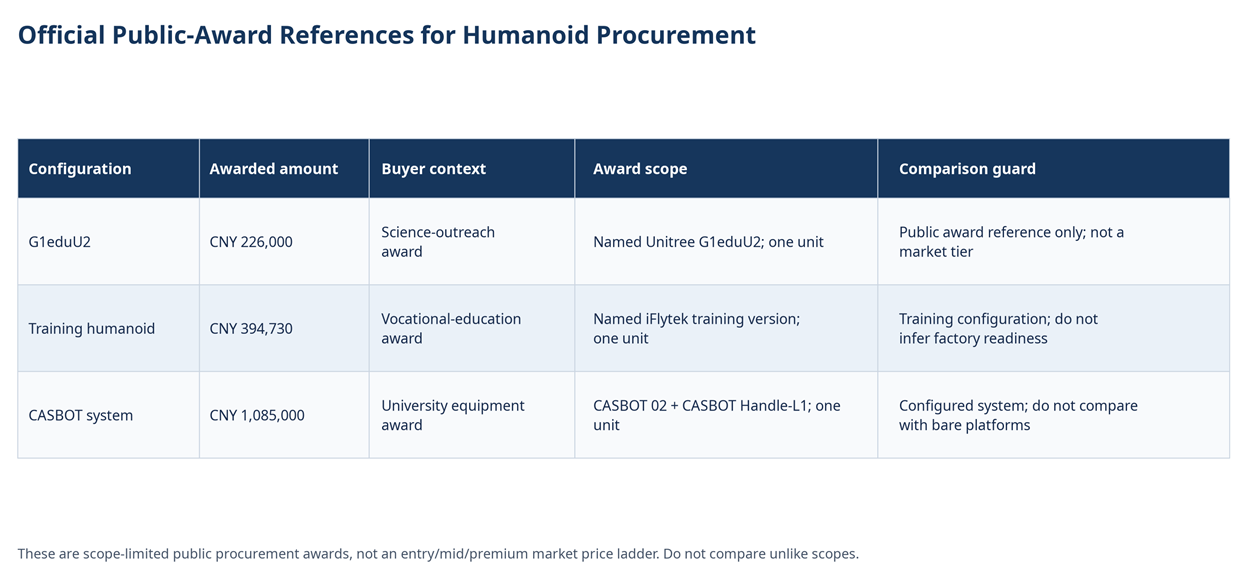
A procurement team should start with the use case already defined in the prior deployment analysis. For a training or research application, the first budget question is whether the quoted configuration includes the required software, teaching content, peripheral equipment, commissioning, and training. For an industrial task, the question is whether the quote includes the end effectors, safety design, integration work, performance acceptance criteria, service response, spare parts, and site changes needed to make the machine operational. A base robot price without those fields is not an investment case.
China vs Global Price Gap
No qualifying official source supports a side-by-side China-versus-global humanoid price gap. The three Chinese award records are public and model-scoped, but they are institutional purchases with different purposes. The European Union procurement record titled “Humanoid Robot” reports a final contract value of EUR 243,192.39 for a bimanual mobile manipulator for geriatrics tasks. It does not disclose a one-unit humanoid price, and its research-contract scope differs from the Chinese awards.
It would therefore be misleading to convert currencies and calculate a percentage gap. Currency conversion would create a numerical comparison without making the robots, contract terms, or procurement purposes comparable. The buyer-level conclusion is more useful: use public awards to establish that several price points exist, but do not use them to claim that one country is categorically cheaper than another.
Instead, request comparable quotations in a common scope. The quote request should state the robot configuration, included manipulators or tools, software term, installation and commissioning responsibilities, safety and acceptance test, warranty, support response time, spares, shipping, taxes, and any facility modification. Only then can a China-based and a non-China-based bid be evaluated as alternatives rather than as unrelated invoice totals.
What Drives the Price
The main price driver visible in the official records is configuration scope. The CNY 1,085,000 public award names both CASBOT 02 and CASBOT Handle-L1, while the CNY 226,000 record names a G1eduU2 configuration. That difference does not prove which machine is better. It shows that model identity alone is insufficient; the buyer needs the full delivered configuration.
A second driver is acceptance scope. Public awards may cover education, science outreach, or university equipment. An enterprise deployment can require a different package of task tooling, system integration, training, validation, maintenance, and safety work. These costs should be collected as distinct quote lines. Combining them into a single robot-price comparison hides the part of the budget that determines whether the application can run after delivery.
A third driver is market access. The United States Federal Communications Commission (FCC) states that new qualifying foreign-produced advanced robotic devices, a category that can include certain connected humanoid robots, generally cannot receive equipment authorization for import, marketing, or sale without the applicable approval process. For a United States deployment, regulatory eligibility is not a peripheral legal note. It can change which model may be quoted, the evidence required from the supplier, and the cost of a compliant sourcing path.
Price Trend
The official evidence does not support a statement that humanoid robot prices have been rising, falling, or remaining stable over the past two to three years. The available award values are for different models, configurations, buyers, and purposes. Treating their dispersion as a trend would confuse product mix with time. The appropriate editorial answer is not a directional forecast, but a disclosure: a verified comparable series is unavailable from the official sources reviewed.
That gap matters because a buyer who assumes a rapid price decline may defer a necessary pilot, while a buyer who assumes price stability may overcommit before the support and integration model is mature. The defensible method is to keep a controlled internal quote log. Record the same five fields for each quote: configuration, included tools and software, integration and commissioning, support and warranty, and regulatory or sourcing assumptions. A trend can be calculated only after the organization has repeated observations for a comparable scope.
Benchmark Reference
It requires every proposed budget to be tagged as one of three evidence states: a public award reference, a supplier quotation, or an operating deployment budget as there is no benchmark reference in today's context.
It requires the buyer to state which tasks are included, what proves acceptance, who owns integration, how software and support are charged, and whether the targeted geography creates a sourcing constraint. A public award can anchor a preliminary budget discussion, hence until a comparable benchmark is established, it will mainly be seen and used in public sector and very selected well-funded organizations.
The forward-looking procurement thesis is clear. As humanoid platforms move from demonstrations to bounded work, the winning budget discipline will not be the buyer that finds the lowest headline figure. It will be the buyer that converts every headline figure into a comparable delivered-system scope before approving a pilot.
This analysis synthesizes company statements, exchange filings, and public market activity; figures reflect disclosures available as of the information cut-off of August 13, 2026.
Disclaimer: This article is for general information purposes only and does not constitute investment, legal, or procurement advice. Readers should verify details with primary sources before making business decisions.