Nearly 30 Robotaxi Companies Now Build on NVIDIA's Stack
NVIDIA's own account of its automotive partnerships shows nearly 30 robotaxi and AV companies, from Uber and Waymo to Pony.ai and Tesla, now building on its compute and simulation stack as the industry consolidates around shared infrastructure ahead of a projected US$400 billion 2035 market.

SANTA CLARA, California, September 10, 2026. Nearly thirty companies building robotaxis and autonomous vehicles, including Uber, Waymo, Zoox, Pony.ai, Momenta, WeRide, Tesla, Mercedes-Benz and Hyundai Motor, are now building some part of their driverless stack on NVIDIA's compute and simulation platform, according to a survey NVIDIA published of its own automotive partnerships. The roster spans direct competitors that rarely appear in the same sentence, and it illustrates a structural shift in how the robotaxi industry is being built: fleets that compete fiercely for riders are increasingly renting the same underlying compute layer to get there.
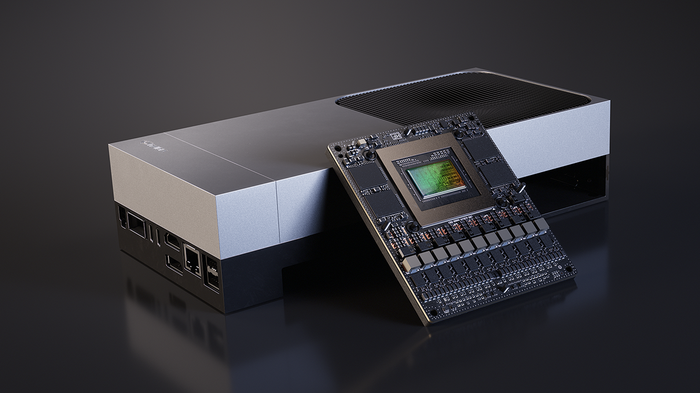
NVIDIA is a Santa Clara-based chipmaker whose graphics processing units power most of the world's AI model training, a position it has spent the past several years extending into automotive-specific hardware and software under its DRIVE brand. That extension is the subject of Thursday's disclosure, which names DGX systems for model training, the Alpamayo vision-language-action model family, Omniverse NuRec for reconstructing real-world driving scenarios in simulation, Cosmos for generating synthetic training data, the DRIVE Hyperion sensor and compute architecture, DRIVE AGX Thor systems-on-chip for in-vehicle inference, and a safety validation framework called Halos, as the pieces of a stack that customers can adopt in whole or in part.
A Market Consolidating Around Shared Infrastructure
The robotaxi industry looked, as recently as two years ago, like a race between vertically integrated bets: Waymo building its own sensor suite and compute from the ground up, Tesla insisting cameras alone were sufficient without the lidar and specialized compute other players use, and a wave of Chinese entrants including Pony.ai, WeRide and Momenta developing largely independent technology stacks aimed at their home market first. NVIDIA's own accounting of its customer list suggests that divergence has narrowed. Companies that started from very different technical philosophies, camera-only versus sensor-fused, US-first versus China-first, robotaxi-native versus automaker-led, are now drawing on overlapping pieces of the same compute and simulation infrastructure, even when their finished vehicles and business models remain distinct.
That consolidation matters commercially because it changes where the real competitive advantage sits. When every serious entrant can license roughly comparable training compute, simulation tooling and in-vehicle silicon, the differentiation shifts toward data, deployment execution and regulatory navigation rather than raw computing capability. A fleet operator's edge increasingly comes from how many real-world miles it has logged, how quickly it can convert edge cases into retrained models, and how well it manages the unglamorous work of permitting, insurance and city-by-city rollout, not from whether its chips are marginally faster than a rival's.
The Scaling Problem Behind the Partnership Roster
NVIDIA framed the core technical challenge in blunt terms: deploying a single driverless vehicle safely is one problem, and scaling that vehicle into a fleet of thousands operating across multiple cities is a distinct, harder computing problem. That framing is not just marketing language. It reflects a real operational bottleneck, since a model that performs well on the roads it was trained and validated on can fail in new cities with different traffic norms, road markings, weather and pedestrian behavior, and retraining a fleet-wide model for every new market is prohibitively slow if it has to be done from scratch.
NVIDIA said its Alpamayo model family improved trajectory-prediction accuracy by 43 percent when trained with reasoning-augmented data, meaning training examples that include an explanation of why a driving decision was correct, not just the outcome. For a fleet operator planning geographic expansion, that kind of transfer-learning improvement is directly tied to the pace at which a new city can go from pilot to commercial service, since faster, more reliable trajectory prediction reduces the number of real-world miles needed to validate the system before regulators and internal safety teams approve wider deployment.
Uber, which does not build its own vehicles but orchestrates rides across multiple robotaxi partners, said it intends to expand robotaxi availability to 28 cities by 2028. That target is instructive because Uber is effectively betting that the underlying technology stack, largely NVIDIA's in this case, will mature fast enough to support that pace of expansion across partners as varied as Waymo, Pony.ai, Momenta and May Mobility, each running different vehicles and, in some cases, different NVIDIA product tiers.
What This Means for Buyers Outside the Robotaxi Race
The direct audience for this roster is a narrow one, a few dozen companies with the capital to build or operate autonomous vehicle fleets. But the underlying platform shift has implications for a much wider set of buyers evaluating physical AI for warehouses, factories and logistics fleets, because the same DRIVE Hyperion sensor architecture, DRIVE AGX Thor compute and Alpamayo-style reasoning-augmented training methods are derivatives of, and in some cases directly shared with, NVIDIA's Isaac platform for industrial and mobile robots. A company evaluating an autonomous mobile robot vendor for a distribution center is, whether it realizes it or not, evaluating a smaller-scale version of the same compute and simulation stack now consolidating the robotaxi industry.
The market NVIDIA and its partners are chasing is not small. NVIDIA cited third-party estimates that the robotaxi market will reach US$400 billion by 2035, with more than 6 million commercial vehicles in operation, an eightfold or larger expansion from the handful of cities running limited commercial service in 2026. Reaching that scale requires exactly the kind of shared infrastructure NVIDIA is describing, because no single company, not even one as large as Uber or Tesla, can independently fund the compute, simulation and validation work needed to certify autonomous driving across thousands of distinct urban environments.
The Limits of a Single Vendor's Own Account
Every figure in this survey, the partner roster, the 43 percent trajectory-prediction improvement, the 28-city target, comes from NVIDIA's own characterization of its customer relationships and its partners' public statements, not from an independent audit of how deeply each named company actually relies on NVIDIA's stack versus its own proprietary technology. Tesla, for instance, has spent years publicly arguing its camera-only approach and custom silicon reduce dependence on outside suppliers, and its inclusion in NVIDIA's roster likely reflects a narrower slice of the relationship, simulation tooling or specific chip purchases, than the deep, full-stack adoption implied by companies like Zoox or Pony.ai. Buyers and investors reading this kind of platform narrative should treat the partner list as evidence of NVIDIA's commercial reach, not as proof that competitive differences between these companies' actual driving systems have disappeared.
There is also a concentration risk worth naming plainly. An industry that consolidates around one company's compute, simulation and safety-validation stack creates a single point of technical and commercial leverage for that company, one that becomes more consequential as the robotaxi market scales toward the multi-hundred-billion-dollar figures NVIDIA and its partners are forecasting. Fleet operators betting their expansion timelines on NVIDIA's roadmap are also betting that NVIDIA's pricing, chip supply and product priorities stay aligned with their own over a multi-year buildout, a dependency that regulators and large fleet customers alike are likely to scrutinize more closely as the market matures past its current early-adopter phase.
The number worth tracking over the next year is not how many logos appear on NVIDIA's partner slide but how many of the smaller, less-capitalized entrants on that list, companies like Tensor, Waabi and DeepRoute.ai, actually reach commercial fleet scale rather than remaining permanently in pilot status. A shared compute stack lowers the technical barrier to entering the robotaxi race, but it does not remove the far larger barriers of regulatory approval, insurance, and the slow, city-by-city work of proving a driverless fleet is safe enough for a regulator to sign off on unsupervised operation.
How Fleet and Logistics Buyers Should Read the Signal
For a logistics or fleet operations buyer who will never operate a robotaxi, the more useful takeaway is procurement leverage. Software and simulation tooling built for the robotaxi market, particularly reasoning-augmented training methods like the one behind Alpamayo's 43 percent accuracy gain, tend to migrate downward into cheaper, lower-stakes autonomy categories within a year or two, the same pattern that took automotive-grade lidar from six-figure research hardware to sub-US$1,000 components sold into warehouse robots. A buyer evaluating autonomous forklifts, yard trucks or last-mile delivery robots today should ask incumbent vendors directly whether their roadmap inherits any of this reasoning-augmented training approach, since a vendor still training on outcome-only data without the reasoning layer is working from a method the highest-stakes segment of the industry has already started to move past.
The procurement question that matters most in the near term, though, is vendor lock-in. A robot or fleet vendor built entirely on one chipmaker's proprietary tools carries a different long-term risk profile than one built on more portable, hardware-agnostic software, particularly for a buyer signing a multi-year deployment contract. That does not make an NVIDIA-based platform a bad choice, given how much of the industry is converging there, but it is a question worth raising explicitly in any vendor evaluation rather than assuming the underlying compute stack is interchangeable if a buyer later wants to switch suppliers or negotiate on price.
Hero image credit: NVIDIA.
This analysis draws on public statements and technical materials released by NVIDIA describing its automotive and robotaxi partnerships, alongside public statements from named partner companies regarding their own expansion plans. It is for general information purposes only and does not constitute investment, financial, or legal advice.